

Discover of the Oseberg ship in 1903:

.
In 1960, the archeological remains of a Viking settlement were discovered in Newfoundland at L’Anse aux Meadows, proving definitively that the Vikings actually did reach North America. The only “evidence” up to this point were the accounts recorded in the ancient sagas. Sixty-seven years before this discovery, upon reaching the coast of Newfoundland, the crew of 𝘝𝘪𝘬𝘪𝘯𝘨 proved–for the first time ever–that such a voyage was indeed possible with a Viking ship. What is even more remarkable is that she was a replica of the Gokstad, which was not designed for long ocean voyages
Source: Redirecting...
The Vikings did more than raide places in Scotland, England, Ireland and France.
They settled and developed trading towns that have evolved into well known cities:
They also left place names, words and phrases that is still in use in modern days.
Here is a list of some words in the English language that has roots in Old Norse:
PS> None of the above linked articles claim to be the full and complete lists of Viking settlements, or words derived from Old Norse in use today.
How about Putin being your distant cusin Dr.Bugge??? If enough local woman were raped and inseminated by Viking warlords then You may have a lot in common. Look how their royalties mixed blood via bed sharing with German /Prussian beauties .
How come You dislike so much your own kin 

Looks to me the Viking thought them CRUELTY & barbarism . You suerely disagree 
Anybody that has forbears in the north of the UK will have Norwegian DNA that will include your old mate Trump.
The big question is; did the Vikings leave some settlers, or offspring of mixed inheritance behind in North America when they withdrew from their settlements there?
There are evidence of some intermingling with the native population (Skjæling):
https://www.nationalgeographic.com/science/article/101123-native-american-indian-vikings-iceland-genetic-dna-science-europe
Did some of the Viking explorer move further inland and settle there?
The myth of a rune stone found in Western Minnesota has been circulating for years:
If not, why didn’t they stay and colonize the place?:
Or did the Irish (Celts) get there first and never left?:
Here is a fairly recent (2023) book about the Vikings in America:
PS> I haven’t read it so not able to comment on the accuracy or anything else in this book.
There have been several crossings from Norway to the Americas in various crafts over the centuries. Some in commemoration of the early Viking voyages, but also one to prove the seaworthiness of enclosed lifeboats:
One of the earliest was the voyage of the replica longship “Viking” from Christiania (now Oslo) to Chicago for the World Fair in 1893:

There is a Facebook page dedicated to this voyage and the ship:
PS> Apparently Red tape is not a new invention:
Proof has been found that there were settlements in the far northern parts of Norway already in the Viking age:
Pretty clever, the row of stops for the tiller -
A very large viking ship from around 800 AD found in Gjellestad, Norway:

Full NG article here:
‘100-year find’: Enormous Viking ship holds surprising clues on burial rituals | National Geographic](https://l.facebook.com/l.php?
The largest replica Viking ship built in recent years:
Bjørkedalen isn’t even at the sea, but there have been boat building there for hundreds of years:
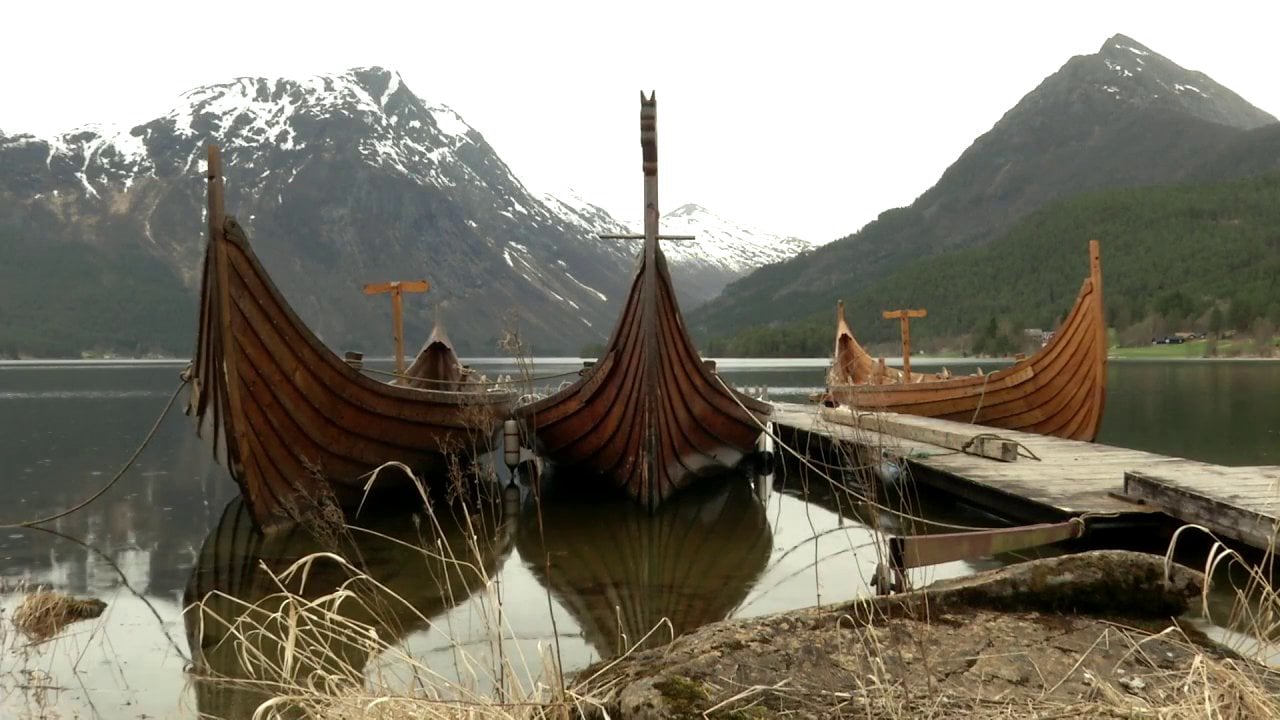
Like to make an Atlantic crossing onboard a Viking ship?:

Once upon a time Norway “ruled” large parts of NW Europe and the North Atlantic, known as the Norwegian Realm (Noregsveldi) refers to the vast medieval kingdom of Norway at its peak in the 13th century, encompassing mainland territories like Jämtland and Bohuslän, and overseas possessions such as Iceland, Greenland, Shetland, Orkney, and the Hebrides, ruled by the Norwegian king but often as a commonwealth of tributary lands rather than a unified state. This powerful realm emerged after civil wars, reaching its greatest extent under King Håkon IV Håkonsson (1217–1263).:
Key Aspects of the Norwegian Realm:
- Territorial Extent: At its peak, it included modern Norway, parts of Sweden (Jämtland, Herjedalen, Bohuslän), and extensive North Atlantic territories like Greenland, Iceland, the Faroe Islands, Shetland, Orkney, and the Isle of Man.
- Nature of the Realm: It was a collection of kingdoms and peoples, more a conglomerate under a single king than a single national state.
- Tributary Lands: Islands and regions like Iceland and Greenland were considered “tax territories,” with their people subjects paying taxes to the Norwegian king, notes Norwegian SciTech News.
- Peak Power: The period between 1240 and 1319 marked the zenith of the realm’s power, following internal conflict,.
- Decline: The realm fragmented, with lands like the Hebrides and Isle of Man ceded to Scotland in 1266, and other areas later lost to Sweden.
Evolution:
- Unification: The unified kingdom began with Harald Fairhair in the 9th century, with a more stable entity forming in the 11th century.
- Dano-Norwegian Union: From 1380, Norway entered long periods of union with Denmark (until 1814) and then Sweden (until 1905), becoming subordinate in these unions.
- Modern State: Norway became a fully independent nation with its own monarchy in 1905.
On part of the “Norwegian Realm” was Greenland and one of the most interesting mysteries from there is; “what happened to the Norse settlements there”?
Another is about when Denmark and Norway almost ended up fighting each other of a part of East Greenland in 1931-33.
Here is the story of Greenland and the Norwegian involvement in it.
(In Norwegian):
Update:
Found an article in English about the Norwegian claim to East Greenland:
https://norwegianhistory.medium.com/when-norway-annexed-greenland-in-1931-5dffde08869c
Here is more details about the Norwegian Realm (in English):

Transfere (or NOT) of islands that was once part of the Norwegian realm is hot in the news these days:

PS: In this case the islanders are the ones who WANT change of sovereign.
Not only Orkney has a history of being part of the Norwegian realm.
It is “Up Helly Aa Week” in Shetland.
The islanders are proud of their heritage and know how to show it:
Here is a video for those who want an in depth view of the festivities:
