
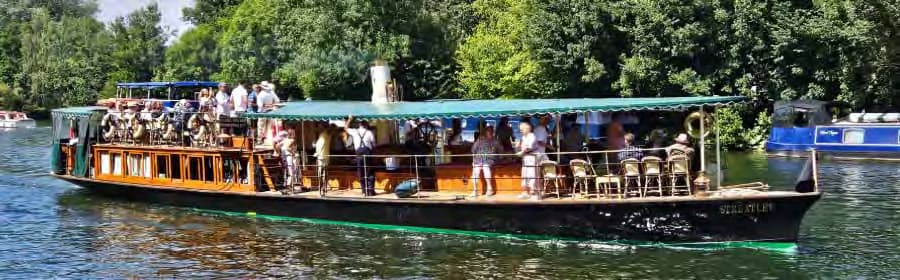
The 1905-built SS Streatley seen steaming through Windsor on 29 June. Streatley was built for service on the River Thames between Oxford and London and still operates on the lower reaches around Windsor. She has a McEwan Scotch boiler and Sissons coal fired and triple expansion engine.
Photo: Mike Deegan FIH, Secretary, the Maritime Skills Alliance.
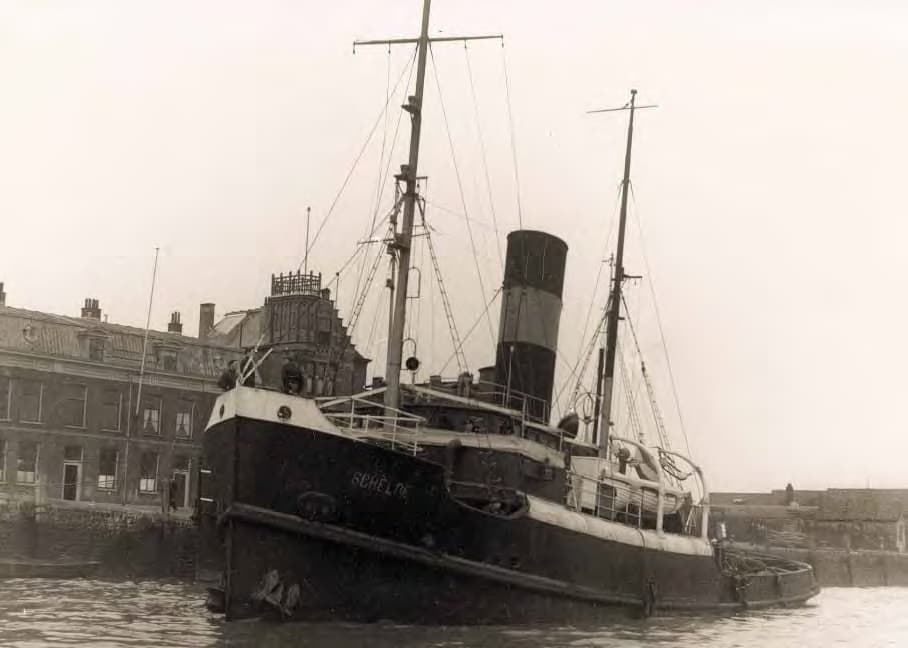
85 years ago today, the SCHELDE returned to the port of Antwerp after departing Maassluis at 6 a.m. on July 10, 1945, after a stay of barely 10 days. She had to wait until July 14 before any towing was required. Outside the Royers Lock, three Camels were moored, bound for Portsmouth. These were large submersible cylinders used to refloat sunken ships. Around midnight, the SCHELDE anchored near Terneuzen, awaiting final orders, and the clock was set back one hour. The next day, around noon, she weighed anchor in the English Channel. Due to an approaching southwesterly storm with high seas, she diverted course to the Margate roadstead on July 16 to seek shelter. The tide calmed somewhat in the evening, and the next morning, the SCHELDE was able to continue her tow. Around noon on the 18th, the SCHELDE arrived at Portsmouth and was shortened within half an hour.
Excerpt from the Schelde Journal, Wednesday, July 18, 1945.
The Camels are then picked up by two TID tugs, and the SCHELDE can find its assigned berth in the Empress Dock. This turns out to be alongside the HUDSON. The HUDSON’s crew will then have to wait another three months before mooring in Maassluis, but they are undoubtedly happy with the fresh news from home.
This is part 2 in the series about the mini-exhibition on board the Hudson, chronicling the homecoming of tugs after World War II in the latter half of 1945. The Hudson is moored in Maassluis and is open on Saturday afternoons from 1:30 PM to 4:30 PM.
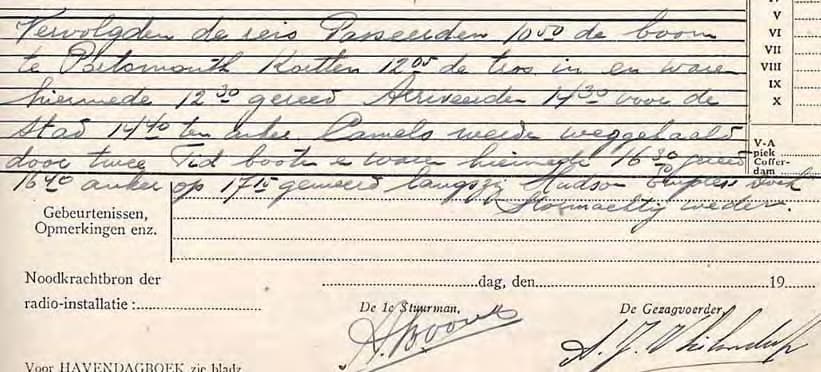
Uitsnede uit Journaal Schelde woensdag 18 juli 1945
Source: Maasmond Newsclippings 192-2025
(Google translation from Dutch original)
Veteran coaster “Saturn” in the Kiel Canal 05. July, 2025:

Hurry up if you want to secure this historic tug and restore it to it’s former beauty:

The local historic tug Sand Man heads out to the race course as drier weather greeted both racers and spectators alike for the 2014 Harbor Days tugboat races on Budd Inlet August 31st. Steve Bloom Olympian file photo
Read more at: https://www.theolympian.com/news/local/article310676175.html#storylink=cpy
Update:
https://www.theolympian.com/news/local/article310687355.html
M/S Ragna Bakke, one of the Norwegian merchant fleet’s most beautiful and fastest liners in the 1960s:

Photo: scanned from the book: “Linjefartens Minnealbum” by Tor Inge Vormedal.
Especially as it was built before extension and conversion.

Photo: scanned from the book: “Vekst og nederlag. Historien om Knut Knutsen O.A.S.” by Tor Inge Vormedal.
She operated by Knutsen Line on the Orient Service from 1961-82.:

She ended active life as a depote ship for oil exploration in Indonesia:

M/S Knut Provider ex Ragna Bakke Photo: Unknown
In January 1975 M/S Ragna Bakke rescues the world’s largest container ship MV Tokyo Bay from grounding:
The story is from the book: LINJEFARTENS MINNEALBUM by Tor Inge Vormedal. Vormedal Publishing House Haugesund.
ISBN-13:978-82996130-7-1 ISBN-10:82-996130-7-8
Google translation from Norwegian
The seamanship involved in manoeuvring the vessel and passing the tow and on the stricken vessel receiving and making fast the tow while fighting an engine room fire in a gale. Epic. On all sides.
What the hell was that towing hawser made of?
This incident happened in 1975. Both natural and syntetic fibers were used to make hawsers at the time, so take a guess.
How the hawser was transferred was not explained step by step. (rocket line, messenger, hawser) The author probably thought that his readers would know that.
MV Tokyo Bay:
I ask because in the navy we practiced towing and carried a dedicated towing hawser (much larger than any berthing lines) which was always connected to the anchor cable of the towed (war)ship led through the centreline bullring and to a centreline dedicated towing slip on the stern of the towing ship.
We also carried two hurricanes hawsers with steel wire rope at each end and a doubled fibre cordage spring in between but not long enough for towing.
Even then, the hawser was fragile enough to be treated with great care when getting the tow to make way. Good speed could be achieved after a while.
I doubt any merchant ship of the era would be this prepared with dedicated hawsers, an ability to break the cable and attach the hawser and bollards aft to withstand full power.
Maybe they did. I don’t know.
The story tells of a magnificent achievement. I just don’t understand how it all held together.


This little ship survived for 60 year in hard coastal trade,
Built as “Steinman” in 1953:

SAR67719530120001 STEINMANN. Photo via Einar Onsøien.
Seen here as “Børre” (1992-2000) operating mainly in the Oslofjord area:


As Telvus (2006 - 2013):

Broken up in Grenå, Denmark 2013.
Source: skipshistorie
MS Nordstjernen is still active at 69:

“Nordstjernen” at the quey in Kopervik. Photo: Arild B. via NSF


MSSLETTER (1936):

Coastal general cargo motor vessel, built Ardrossan Dockyard Ltd, Ardrossan, Scotland, as KINDIESEL for Kindiesel Shipping Co Ltd (manager P MacCallum & Sons Ltd, Greenock; 358 tons gross, 400 tons deadweight; 1941 sold Lovering & Sons Ltd, Cardiff; 1951 sold Skibs-A/S Karlander (manager Egil Paulsen, Oslo), renamed SLETTER; 1956 sold Trygve Klovning, Haugesund, renamed SENATOR; 1957 sold A/S Borgundøy (manager Abraham Bjellebø), Haugesund; 1966 sold Gunnar Årseth Partrederi, Ålesund; 1969 crank bearing damage, grounded and sank at Fjälskären near Vinga lighthouse, Sweden, 21 January (voyage Gothenburg-Helsingborg, in ballast)
(Image from Skyfotos print 1956, Dover Strait southbound)
M/S PLEASANTVILLE 8.350 tdw, 4.951 brt, 2.860 nrt. Blt.

1945 Contracted 05/07 by Skibs-A/S Mandeville.
1946 Contract taken over by Skibs-A/S Goodwill 20/12.
1949 Built as M/S PLEASANTVILLE by Eriksbergs mekaniske Verkstads A/B, Gothenburg, Sweden for Skibs-A/S Goodwill (AF Klaveness & Co. A/S, Lysaker), Oslo. Launched 09/06, christened by Ôvertstinnan Tarras-Wahlberg. Completed 15/09.
1962 Sold to Universal Shipping & Trading Agency A/S (AF Klaveness & Co. A/S, Lysaker), Oslo.
1963 Sold to Bruusgaard Kiøsteruds Skibs-A/S (Bruusgaard,
Kiøsterud & Co.), Drammen, renamed HERO .
1969 Sold to Farcom Enterprises Ltd (Pacific International
Lines (Hong Kong) Ltd, Singapore), Mogadishu, Somalia
renamed HAI SHEONG .
1977 Sold to Pacific International Lines (HK) Ltd,
Singapore.
1978 Sold to Pakistani shipbreakers for USD 76/LDT.
Arrived Gadani Beach, Pakistan 07/03. Cutting commenced in May at ZM Industries.
Source: Lloyd’s, DnV, Starke, Skipet 4/85- by Per H. Kjærvik & Arne Tandberg, book Eriksberg-Ett storvarv och dess fartyg.
Skipshistorie.net.

More from Jann Inge Bakkeid and his experience while onboard MS Finnmarken:
Source: https://www.facebook.com/groups/865224253658886/user/583710498
(Google translation)

M/S “ANNE” 730 TDW blt. 1948.
Seen here as “Turihaua” during a call at Wellington. Photo: Unknown.
M/S Anne: M/S Anne - Sjøhistorie
M/V Turihuana: Turihaua | Ships Nostalgia


In a campaign against the use of fossil gas Greenpeace currently deploys their ARCTIC SUNRISE to various ports around Europe. Following a weekend in Stralsund the 1975 built 1,017 gt vessel passed Kiel westbound on Sep 16 heading for the next scheduled event at Oostende Sep 20-21. Greenpeace acquired the former seal catcher POLARBJORN in 1995 and shehas since been used for numerous missions around the world. Text/photo : Martin Lochte-Holtgreven (c) (Maasmond Newsclippings 261-2025)
Polarbjørn:

On expedition in Antarctica 1986-87
https://www.ishavsmuseet.no/skutekatalog/polarbjorn-iv/
