
Bernie Sanders ad with Moran Tugs

here is one much too juicy to pass up on posting

F-35 helmet costs $400,000 — 4 times that of predecessor

By Phillip Swarts, Staff writer October 26, 2015

When the joint strike fighter, the F-35 Lightning II, finally takes to the skies on its first official mission, it will be one of the most advanced and one of the most expensive planes ever.

And the pilots flying the aircraft will be wearing the most advanced and most expensive helmet ever.

The helmet will give pilots quicker access to the information they need to see and has special cameras to “see” through the bottom of the plane. But it will cost an estimated $400,000 per helmet — more than four times as much as the Air Force paid for head wear for other aircraft such as the F-16.

Helmets for all the F-35s scheduled to be purchased will cost at least $1 billion, Air Force Times estimates.

The helmet makes use of six cameras embedded in the skin of the plane to give pilots a 360-degree view of the surrounding airspace, including enabling them to “look through” the floor of the plane. Plus it has advanced night-vision capabilities built in; and the heads-up-display projects directly onto the visor, putting information like altitude, speed and targets right in front of the pilots’ eyes.

AIR FORCE TIMES

F-35 helmet is 6 ounces too heavy

It is also larger and heavier than helmets for other aircraft. And that has spawned its own set of problems. One pilot has complained that it bangs into the canopy, and recent tests have shown that it can make ejecting more dangerous for lighter pilots. As a result, the F-35 program office has ordered a new lighter helmet which will be available in 12 to 18 months.

And just like everything else about the F-35, the helmet has led to a split on whether the cost is justified for new advanced systems or a waste of taxpayer dollars.

Air Force Chief of Staff Gen. Mark Welsh said the helmet is the key to giving pilots capabilities they haven’t had before.

“The helmet is much more than a helmet, the helmet is a workspace,” he told Air Force Times. “It’s an interpretation of the battle space. It’s situational awareness. Calling this thing a helmet … we’ve got to come up with a new word.”

Pentagon and defense contractors insist that reported problems with the helmet have been fixed. But the high price tag has left many oversight experts and members of Congress wondering if the tab is worth it.

“The designers of this have come up with a very complicated, very finicky solution for a relatively simple problem,” said Dan Grazier, with the Project on Government Oversight.

Grazier, an expert at POGO’s Center for Defense Information, said he believes the helmet is “symptomatic of a larger problem” — that designers are trying to stick too many features on the plane and its systems.

“We need to stop trying to make this thing all things to all people because it winds up becoming useless to all people after a while,” he said. “The characteristics of a good fighter plane are very different than the characteristics of a good close-air support aircraft.”

Rockwell Collins, a subcontractor working on the helmet, directed all questions to Lockheed Martin. The company also declined to provide cost data on the helmet, but said that the information had already been made public by other reporting. It directed Air Force Times to a Washington Post article that found the cost of each helmet was $400,000.

Air Force officials confirmed that $400,000 was an accurate estimate, but noted that the helmet cost is incorporated in the overall cost of the plane, so pulling out a specific cost for a specific component can be difficult.

Each helmet is created uniquely for each pilot, and built to match the measurements of the pilot’s head to ensure it fits comfortably and snugly. That means that every single person who flies an F-35 will have his or her own helmet.

The Pentagon is expected to buy roughly 2,400 F-35s, with 680 going to the Navy and Marine Corps and the rest going to the Air Force.

If each helmet costs $400,000 and each of the 2,400 F-35s has a pilot, the bottom line cost for helmets is $960 million — not taking into account that pilots retire and are replaced by pilots with different-sized heads.

Troubles in testing

Issues were raised anew about the plane earlier this year, after a test flight pitting the F-35 against an F-16.

An internal Lockheed Martin memo, first leaked by the website “War is Boring,” showed that the F-35 was having difficulty dogfighting against the older aircraft.

“The F-35 was at a distinct energy disadvantage in a turning fight,” the report said, and when it came to trying to operate the aircraft in a high angle of attack, “it wasn’t effective for killing or surviving attacks,” the report said.

The problems extended to the helmet as well. The internal memo noted the pilot’s helmet kept smacking into the canopy when the pilot tried to turn around.

“The helmet was too large for the space inside the canopy to adequately see behind the aircraft,” the report said. “There were multiple occasions when the bandit would’ve been visible (not blocked by the seat) but the helmet prevented getting in position to see him.”

Indeed, one of the recommendations on the report was to “consider improving rearward visibility by creating more space for helmet motion.”

And the problem had a second side-effect.

“Whenever the helmet was pinned against the canopy, the pilot continued to strive to turn his neck,” the report said. That means the information on the Heads-Up-Display needed to fly and fight was no longer right in front of the pilot’s eyes.

But Lt. Col. Michael Gette, commander of the 61st Fighter Squadron at Luke Air Force Base, Arizona, and an expert on the F-35, said he’s never noticed the issue.

“I’ve been flying this airplane for a couple of years now and I do not have a problem with that,” he said. “There’s plenty of room to maneuver it in the cockpit. There’s a little bit of a learning curve. The equipment is brand new, just takes some getting used to. And once you figure out how to get it fit correctly and how to get all the cords routed correctly in the airplane and fly it for a while it becomes a non-issue.”

Gette said the F-35 is still undergoing testing and evaluation, and that some difficulties are to be expected.

“This is a brand new airplane. Obviously as a jet first comes out there’s going to be some limitations as they’re testing the airplane,” he said. “Like with the airplane, the helmet is a pretty big leap in technology. We’re trying to do things with the helmet that’s never been done before.”

At one point, in 2011 the Air Force had such little confidence in the helmet that it contracted another company — BAE Systems — to begin creating an alternative.

The original helmet, then in its Gen 2 iteration, was facing criticism that the visor-projection system wasn’t working. Misalignments meant blurry images and some reports of pilot headaches, and there were issues with the heads-up display not properly displaying all needed data.

But Lockheed Martin and its subcontractors were able to fix the problems enough to satisfy the Pentagon, which canceled the second helmet in October 2013.

Pilots like helmet

Officials at both the Air Force and Lockheed Martin have acknowledged early problems with getting all the helmet’s systems operational, but said they believe those issues are in the past.

Welsh said the pilot response to the helmet has been positive.

“All the people flying the airplane — from the time I came into this job three years ago and started asking about the problems I kept hearing about with the helmet — not a single one of them has said ‘Yeah, I don’t want to use it,’” Welsh said. “It’s a pretty incredible capability, and they adapt very quickly to it.”

Billie Flynn, a Lockheed F-35 test pilot, said the headgear has been a big hit for operators.

“Every single pilot that’s ever flown with this helmet loves the helmet,” he said.

Because of the information projected onto the visor, pilots have quick access to the data they need to fly the plane, Flynn said.

“It becomes intuitive that wherever you want to go, that information’s in front of both eyes,” he said. “It’s that split-second less time required to be able to look and target and all the information’s directly in front of your two eyes instead of having to look down at a screen.”

Flynn said he has had no issues with the size of the helmet, and has been able to turn his head freely in the cockpit. But he reiterated that the F-35 is not designed for close engagements.

“It’s hard to imagine that anyone is ever going to jump up unseen and I’m going to have to fight my way out like I did in [a fourth generation aircraft],” he said. “If I find myself in a visual air combat scenario in an F-35, I have colossally failed to take advantage of the stealth capabilities and sensors.”

Col. Todd Canterbury, F-35 Integration Office operations division chief, said he agrees that the helmet is comfortable.

“The helmet itself is very well balanced, so the center of gravity is more on top of my head preventing neck strain with all the additional sensors that I’m carrying,” said Canterbury, a former Thunderbirds pilot who’s logged more than 200 flight hours in the F-35.

“I’ve worn the helmet for over seven hours in different sorties at Eglin [Air Force Base in Florida] and never did I have a hot spot develop,” he said, using terminology for pressure points and other places on the head that can become uncomfortable during long flights.

Canterbury said he’s had no problems maneuvering in the cockpit with the helmet on.

“Yes, the cockpit is a little constrained, but I’ve found that I can turn all the way around and look between the tails without adversely affecting the helmet,” he said. “There is less space because of the large visor, and we’re continuing to make improvements to that.”

The helmet and the capability it brings — especially the heads-up display on the visor — greatly aid in situational awareness and don’t distract the pilot during critical engagements, he said.

“This is the easiest airplane I’ve flown in 4,100 hours of flying fighters and I think the helmet really helps with that,” Canterbury said. “I don’t have to go hunting for information, it’s right there. It’s priceless, I don’t have to take time searching for the information or distracting my eyes away from the target.”

The investment the Pentagon has made into the helmet is critical, Canterbury said.

“It’s worth every penny because we owe it to the men and women that are defending our nation — it’s an all-volunteer force — to give them the best equipment that we have to keep them safe, survivable and lethal,” he said.

The Air Force F-35 will reach initial operating capability next year. Until then, the service is testing the aircraft and fixing anything found wrong, Canterbury said.

“We’re proud of the way the airplane is developing,” he said. “She’s got some warts, but we’re exposing them and she’s going to be great.”

every single thing that is WRONG with the festering corrupt system of defense procurement is demostrated here!
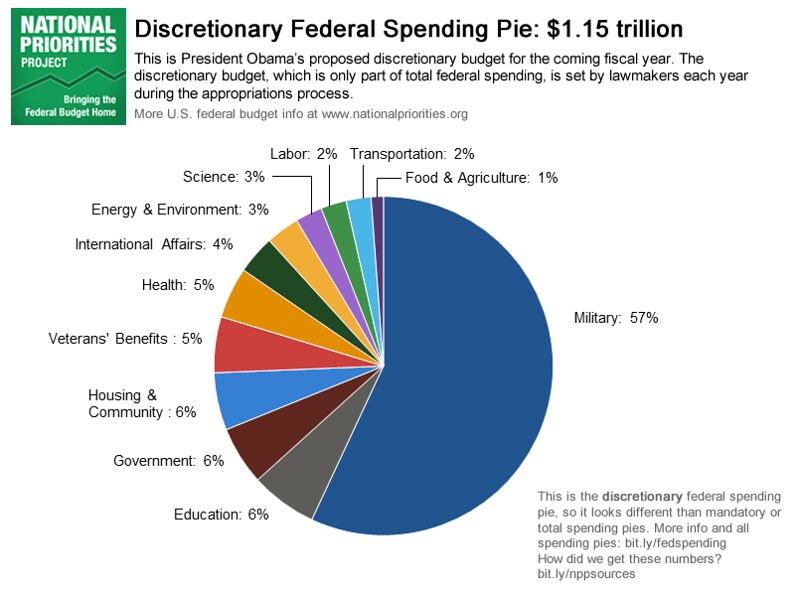
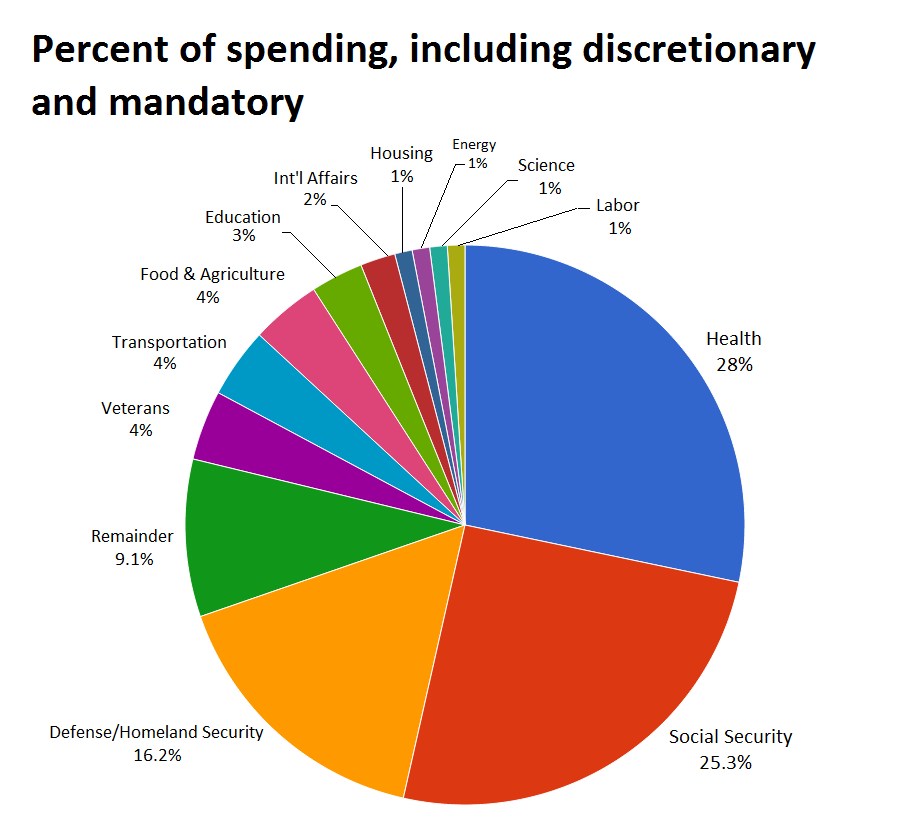
[QUOTE=c.captain;177878]still, this chart shows a very sobering picture of where Congress loves to pour the money and for what? Certainly not to fight ISIS or Al Quaeda with ballistic missile subs, aircraft carrier battle groups or F35 fighters!

OUR MILITARY IS TOO BIG AND MUCH TOO EXPENSIVE CONSIDERING THE THREATS THE NATION CURRENTLY FACES!

.[/QUOTE]

That chart is just DISCRETIONARY spending. Total 2015 Defense/Homeland spending was 16.2% of all federal spending.

Medicare and Social Security are not discretionary because they are NOT funded from the the general revenue but through withholdings specifically for such programs and are mandated by law to be treated as separate expenditures.

Thus a full one half of that money which is discretionary is going to defense. I have no problem with having a military but it needs to be the right sized military to suitably protect the Nation from conceivable threats rather than any potential threat no matter now unlikely. Should we plan to have a military large enough to fight the entire rest of the planet against us no matter that the vast majority of other nations are out allies today and have been our allies for many decades? How about having a military big enough to fight aliens from space? Could happen you know…just ask Hollywood!

WE MUST CEASE SPENDING MORE THAN 20% OF OUR NATION’S DISCRETIONARY REVENUES ON DEFENSE (ESPECIALLY WEAPONS PROCUREMENT) OH BUT HOW GENERAL DYNAMICS, ET ALL WOULD HOWL! CAN’T HAVE THAT!

But you would be totally cool with spending over 50% on the layabouts of the idle class right while raping the pocket of the middle class?

You are referring to what Veblen called the “Leisure Class” - he has this to say: "

…useless activities that contribute neither to the economy nor to the material production of the useful goods and services required for the functioning of society; while it is the middle class and the working class who are usefully employed in the industrialised, productive occupations that support the whole of society.

[QUOTE=c.captain;177883]Medicare and Social Security are not discretionary[/QUOTE]

No joke braniac, but it’s disingenuous to use that graph which makes people think we spend over 50% of the federal budget on the military when WE DON’T. Defense spending is a significantly smaller chunk than your graph illustrates and is really just a drop in the bucket when your talking about the massive social programs you are. We currently spend over THREE TIMES as much on the Social Security and Medicare/Medicade than we do on defense yet you think if we cut defense spending in half we could make any significant reform with that pittance?

Yes, it would be nice to have a budget surplus but most of the people spreading that graphic around the internet use it to delude people into thinking we could have socialized health care of we cut defense spending some. (We could eliminate defense spending completely and not afford socialized health care.)

[QUOTE=Capt. Phoenix;177886]No joke braniac, but it’s disingenuous to use that graph which makes people think we spend over 50% of the federal budget on the military when WE DON’T. Defense spending is a significantly smaller chunk than your graph illustrates and is really just a drop in the bucket when your talking about the massive social programs you are. We currently spend over THREE TIMES as much on the Social Security and Medicare/Medicade than we do on defense yet you think if we cut defense spending in half we could make any significant reform with that pittance?

Yes, it would be nice to have a budget surplus but most of the people spreading that graphic around the internet use it to delude people into thinking we could have socialized health care of we cut defense spending some. (We could eliminate defense spending completely and not afford socialized health care.)[/QUOTE]

you cannot use spending on the socialized pension and medical care programs as part of total Federal spending because they have their own separate revenue streams which the law states cannot be used for other purposes. Yes, FICA withholding is a tax every worker pays as well as their general income tax but that money goes into its own account and is not to be used for discretionary purposes which includes defense.

Are you one who wishes to do away with “social” security and medicare? Do you believe they are not needed? Are you so well off that you do not intend to take either when you retire? I, on the other hand, and very prepared to take advantage of both programs when I am eligible. I am glad they exist and hope they exist in perpetuity! They are two of the very best programs that exist in this Nation!

One BILLION dollars for special helmets for the pilots of $500M/per F35 fighters however are NOT something which we need or can afford. ISIS has no jet fighters of their own. Our military needs to be focused on the boots on the ground who do battle with these very real enemies of the USA!

is it in any way possible for you to come up with some other Bogeymen to use when challenging my call for reduced defense spending? is every poor person in the US so utterly evil and undeserving of any form of assistance? Have you never once known a person who for some reason did not DESERVE assistance in some form? Do ALL poor people simply need to be kicked into the gutter of our economy to suffer their sorry fate? Afterall this is American where EVERY person has the ability to rise above their situation because of all the unlimited options available. I am sure you have unlimited options available to you and are well on your way to your first BILLION. Hell, with the GREAT system that exists in the US of A, every man, woman and child has a God given right to make their own BILLION. I am well on my way to getting mine…only about 900 years to go before I get there!

of course, we could return to the era of workhouses to get some little effort out of the miserable wretches before they get their cold gruel

“Are there no prisons?” asked Scrooge.

“Plenty of prisons,” said the gentleman, laying down the pen again.

“And the Union workhouses?” demanded Scrooge. “Are they still in operation?”

“They are. Still,” returned the gentleman, “I wish I could say they were not.”

“The Treadmill and the Poor Law are in full vigour, then?” said Scrooge.

“Both very busy, sir.”

“Oh! I was afraid, from what you said at first, that something had occurred to stop them in their useful course,” said Scrooge. “I’m very glad to hear it.”

“Under the impression that they scarcely furnish Christian cheer of mind or body to the multitude,” returned the gentleman, “a few of us are endeavouring to raise a fund to buy the Poor some meat and drink, and means of warmth. We choose this time, because it is a time, of all others, when Want is keenly felt, and Abundance rejoices. What shall I put you down for?”

“Nothing!” Scrooge replied.

“You wish to be anonymous?”

“I wish to be left alone,” said Scrooge. “Since you ask me what I wish, gentlemen, that is my answer. I don’t make merry myself at Christmas and I can’t afford to make idle people merry. I help to support the establishments I have mentioned: they cost enough: and those who are badly off must go there.”

“Many can’t go there; and many would rather die.”

“If they would rather die,” said Scrooge, “they had better do it, and decrease the surplus population.”

I have given up on the first million, let alone billion. But then again I’m not American and it is not my God given right to get rich, no matter what.
By the way, Sir Richard Brenson say that the best way to become a Millionaire is to start from being a Billionaire.

Most people screaming socialist when they mention Sanders have no clue about what democratic socialism is. They get confused as they think communism and socialism are the same which is ludicrous. Denmark is a country most consider democratic socialist. Forbes magazine ranks Denmark #1 in the world for business. In the US there has been socialism for years ! The difference is the majority of the the “socialism” benefits the .1%. 14 TRILLION dollars to the Wall St boys to bail them out of their bad bets because they were “too big to fail” comes to mind. Obama was one of the biggest recipients of Wall St money in the history of any candidate so that is no surprise. The poor, the immigrants and the lazy are rank amateurs when it comes to getting government handouts compared to the super rich. But since the super rich own the media we are not told what they are up to. The average income of a working family in the USA is now $52000, in most cases two people are working. Hillary and Trump made that much in the first few days of 2016 just by making speeches. The US congress, Republican and Democrat, along with Obama are soon to pass the TPP which will ship even more jobs overseas. If anyone believes there is a difference between the mainstream political parties they are delusional.
Vote NO incumbent.

[QUOTE=c.captain;177900]you cannot use spending on the socialized pension and medical care programs as part of total Federal spending because they have their own separate revenue streams which the law states cannot be used for other purposes. Yes, FICA withholding is a tax every worker pays as well as their general income tax but that money goes into its own account and is not to be used for discretionary purposes which includes defense.[/QUOTE]

The fact that the first graph you show is misleading stands. Further, my point is that spending on the limited and dismal social security and Medicare systems already in place are so astronomical that cutting the tiny defense spending chunk even in half wouldn’t even come close to funding socialized health care. Again, I agree with cutting wasteful spending but know from where you get your memes. In this case, you got it from people who use it to claim if we cut defense spending we can fund universal college and health care.

      • Updated - - -

[QUOTE=tengineer1;177915]Vote NO incumbent.[/QUOTE]

Congressional term limits!

[QUOTE=Capt. Phoenix;177886]

Yes, it would be nice to have a budget surplus but most of the people spreading that graphic around the internet use it to delude people into thinking we could have socialized health care of we cut defense spending some. (We could eliminate defense spending completely and not afford socialized health care.)[/QUOTE]

True IF you consider that current medical care cost in the USA is the highest in the world. ALL first world countries in the world seem to have found a way to provide universal medical care to their citizens. Of course they don’t have CEOs pulling down multi million dollar salaries and they negotiate for lower drug prices among many other things. At some point the USA must decide if they want to care for the world militarily or take care of their own people at home. The only people that think it is a good idea for the USA to be the world’s policeman are those that profit from it. They consist of the defense contractors and the foreign countries that do not have to pay for their own defense because the USA foolishly does it for them ! The citizens of the USA are being played for suckers by both groups.

I’m all for helping those who help themselves. If someone needs a TEMPORARY helping hand that’s cool and I’m all for it. Surely you hold those from the south who live in trailer parks and suck the govt tit in contempt just because they are from the south. Those who make a multi-generation career are the ones I’m sick of.

I’m far from rich, I’m just a blue collar working man who is tired of being the boogyman for all of the country’s woes. I’m tired of watching those who won’t work live better than me. I’m tired of fucking leftist (and republican) politicians taking my rights and liberties away. I’m tired of illegal immigrants crossing the border and getting immediate “govt assistance” for themselves and their spawn while US servicemen are living in the streets, suffering from PTSD, and waiting months for sub-par care from the V.A. And I’m tired of being called a racist just because I’m a white guy.

I’m not even for or against Trump, I think he is a blowhard too, but he is far and away better than anyone on the left.

[QUOTE=Bayrunner;177920]
I’m not even for or against Trump, I think he is a blowhard too, but he is far and away better than anyone on the left.[/QUOTE]

Hopefully another reality show star besides Trump will join the Republican primary. Maybe one of the Kardashians will decide to run at the last minute and blow Trump off the platform.

and Americans are just so gosh darned thrilled with their government and economic system?

[B]Why North Europeans Are the Happiest People[/B]

Apr 24, 2015

By Leonid Bershidsky

Switzerland, Iceland, Denmark and Norway are the world’s happiest countries, according to the 2015 World Happiness Report, which is put out by some influential economists. Three of these European states are not members of the European Union. What are they doing right that the rest of the world is doing wrong?

Jeffrey Sachs of Columbia University, Richard Layard of the London School of Economics and John Helliwell of the University of British Columbia have been putting out these reports since 2012. They are intended to remind governments that success is about more than economic growth and other such statistics. Sure, people are happier when they’re richer and healthier, as they tend to be in more developed countries, but there are other contributors to perceptions of well-being. That’s what the reports measures: People in various countries are asked how they perceive various aspects of their lives.

The report’s authors say six variables account for three-quarters of the differences in happiness levels among countries: Gross domestic product per capita, social support, healthy life expectancy, freedom to make life choices, generosity and freedom from corruption. Two of these – social support and generosity – are relatively independent of economic development or the political system, which explains why some relatively poor, institutionally weak countries have happier populations than the strongest Western democracies. For example, Mexicans are happier than Americans, Brazilians enjoy higher perceived well-being than the residents of rich, free Luxembourg, and Venezuelans like their life better than Singaporeans.

A country is an all-around winner, however, when it’s rich, healthy, free and populated with generous people who support one another when there’s trouble. One has to wonder if Northern Europe’s Law of Jante might not be responsible for the presence of Iceland, Denmark, Norway, Finland and Sweden among the world’s 10 happiest nations. Scandinavians may scoff at that creed, which makes individualism a crime, but it does make for unusually strong social support networks. That’s how the authors explain Iceland’s surprising resilience during an economic collapse, and its second place in the rankings. That country has the highest percentage in the world of people who say they have someone to count on in times of crisis.

The report contains a chapter that stresses the role of “relational goods,” such as reciprocity and simultaneity (which describes people taking part in meaningful activities together), in building happy nations. People are happier when they’re socially fulfilled, perhaps as members of a group (both group membership and happiness levels are high in Scandinavia):

The happiest countries are participatory. That goes for Switzerland with its direct democracy and tight-knit local communities, as well as for the Scandinavian countries, which, as Sachs wrote in his chapter of the report, have “perhaps the highest social capital in the world.” Participation and deliberative democracy help to build mutual trust, an important part of social capital. People are more willing to pay taxes, less prone to corruption, and expansive social safety nets become the norm.

This kind of social fabric, however, is finely woven and delicate. The happiest countries in the world have small populations (the biggest country in the top 10 is Canada, with 35 million people). Bringing countries together in a big bloc such as the EU doesn’t help increase social capital. And when some countries in such a union do worse than others, their social fabric rips in a dramatic way, trust erodes and the decline in happiness becomes more pronounced than economic losses alone can explain. That’s what happened in Greece, the biggest happiness loser compared with data for 2005-2007. Other big losers are Italy and Spain.

One of the policy implications is that countries need to nourish their natural social fabric rather than seek to impose contrived rules that may have worked elsewhere. For Sachs and Layard, who both advised the economically ultraliberal Russian government after the Soviet Union’s collapse, that appears a revisionist thought. Yet Sachs writes, reflecting perhaps on the largely failed Russian liberal experiment, or perhaps on Greece’s disastrous post-bailout performance:

If the legal rules that are promulgated "run counter" to the social rules and, more importantly, to the moral rules prevailing within that society, then the former will fail to produce the desired results, in that they will not be observed for the simple reason that not all infringers of such rules can be punished. Even worse, they will undermine the credibility and/or acceptability of the other two categories of rules, thus threatening the stability of the social order.

No matter how much we may like big, ambitious programs, aiming for happiness may well mean thinking small and being careful with the fragile web of relationships that make human society function.

and

Get rid of 65% of defense spending and you still can’t sustain the social programs.

perhaps but get rid of buying $400k pilot helmets and the US no longer needs to borrow dollars from China and Saudi Arabia who someday will demand repayment and without a huge burden to pay interest on that debt frees money from the general revenues to put into programs which help the most people like assistance with healthcare and educations which itself then returns to the revenues by having healthier and more educated workers paying income taxes.

[QUOTE=lm1883;177945]Most of those countries that provide socialized medical care cannot afford the costs associated with it. Case and point the province of Ontario medical costs grow 16% annually and there is no way to cap it and the UK system is under intense financial pressure and is looking to have a £30 billion deficit by 2020. If you think these countries provide a superlative health care experience visit any U.S. Hospital on the Canadian border and see how many Canadians are there, more than you probably realize. When you have to wait 70 days for an MRI or 6 months for cataract surgery, tell me how great socialized medicine is then.

It’s worth while to start examining the economic conditions in these European paradises. High debt to GDP ratios, High unemployment, high taxes, because with the exception to Germany, they not doing as well as the the readers of these forums believe. Like you said, it isn’t the top one percent funding these programs, it’s the middle 40% and with a median family income of $50k how far can that go? Get rid of 65% of defense spending and you still can’t sustain the social programs.[/QUOTE]

Where are you from?? Where is these scaremongering situation appearing? Do you know ANYTHING about the world outside USA??
Have you looked at the world reality??
You pay just about the highest tax in the world for the least services. What is your argument???

[QUOTE=lm1883;177945]Most of those countries that provide socialized medical care cannot afford the costs associated with it. Case and point the province of Ontario medical costs grow 16% annually and there is no way to cap it and the UK system is under intense financial pressure and is looking to have a £30 billion deficit by 2020. If you think these countries provide a superlative health care experience visit any U.S. Hospital on the Canadian border and see how many Canadians are there, more than you probably realize. When you have to wait 70 days for an MRI or 6 months for cataract surgery, tell me how great socialized medicine is then.[QUOTE]

As someone who has had medical care in Canada, I found it much more personalized, friendlier, higher quality, much lower cost, and for me much faster. Examples: LASIK eye surgery. The Canadians have been doing it a lot longer, better, and for half the cost in the U.S. with less waiting. Colonoscopy $750 in Canada and $2800 in the US. An American (or Canadian) paying cash or using American Blue Cross insurance often gets much more prompt treatment in Canada than in The US.

Admittedly, Canadians using national healthcare often have long waits, almost as long as US citizens waiting for Medicare or the VA.

and please let us not turn this thread into a political SHITFIGHT here now…everybody is entitled to support the candidate of their own choosing

Famous last word

Here’s the way I see it. In the U.S. We have the Mommy party and the Daddy party. The Mommy party wants to feed the hungry, shelter the homeless and cure the sick. The Daddy party wants to fight wars and make money. In a healthy family dynamic there is give and take, a fairly balanced equilibrium. Mommy and Daddy can’t seem to agree on anything lately, I’m scared they’re going to get a divorce and my petulant little Tea-bagger brother is going to take over.

[QUOTE=lm1883;177971]I have these conversations with Europeans on a regular basis. The first thing I point out is that our Founding Fathers rejected European principles in the establishment of our nation, in fact our government as is it today would probably make Jefferson’s blood run cold (pick up a copy of the Federalist Papers) The second thing I point out is that we have a multicultural population of 370+ million. The reason the Scandinavian systems work is because the social set there is generally homogenous and the populations are small. News flash though, Sweden and Denmark can’t afford their social programs, read up on what’s going on there.

My biggest issue with widening social programs is the dependency that it creates. As our economy constricts (or collapses depending on your point of view) more and more Americans find themselves on the wrong side of prosperity’s border and will be more than willing to cede freedom for economic and social security. Not long after the states arrives in this condition it can no longer afford to provide the safety net that keeps the masses satisfied and the will to make the changes required for solvency are nonexistent. Read the Wikipedia page on the French Revolution and see if anything sounds familiar.

Cutting out expensive flight helmets and aircraft carriers we don’t need might help a little but hard choices are on the way. Ferguson, Baltimore, Oregon, etc are going to become a lot more common before they’re not.[/QUOTE]

The “founding fathers” were against having a standing army. Hence the 2nd amendment. They also were against corporations, one famously stated it was hard to hang a piece of paper for stealing. The constitution of any country is a living evolving document. After the Declaration of independence was signed only people owning land could vote. When Washington was elected only 6% of the people were allowed to vote, states decided who could vote. It was 1856 before all men could vote and only the white ones, no free black and for sure no Native Americans. Whenever elections come around one party or the other wants to take the country back. The question is how far back? The USA is currently under oligarchy rule so perhaps taking the country back from the oligarchs would be a nice start. But this is unlikely to happen as the oligarchs control the media and most citizens are too lazy to read anything out of their comfort zone.