
I agree with you on the size of anchor chain being about 60mm. I wonder if the anchor pictured looked a bit small for the size ship.
Many years ago I was in a warship that let go an anchor at 14 knots due to an inappropriate red light being shown on the bridge at night . The Commanding Officer, WWII vet was demanding to know what was the red light was shinning on the Forecastle for. The Pilot (navigating officer was consulting his notebook with a red shaded torch behind the OOW and CO. The OOW gained no browney points for reporting " It’s alright sir the light has gone out ".
66,000 shp and only 5500 tonnes displacement did an impressive job of stopping before we got to the bitter end. The ones who knew what had happened as it happened, me, a midshipman and a junior signalman did not offer our advice.
The entire ships company were aware what happened.
Baltic subsea cable damage was accidental, not sabotage - US and European officials
As reported by The Washington Post, US and European officials have gathered evidence - including intercepted communications - which have concluded that anchors were dragged across the seabed accidentally because of inexperienced crews aboard poorly maintained vessels.
One European official has sustained there is counter-evidence suggesting otherwise, however, US and European officials have declined to elaborate on the situation.
Anything is possible but that this was an accident doesn’t strike me as very plausible. This article makes it seem like the sources the WP used had access to intercepted communication but perhaps not anyone with maritime experience. .
I’ve just learnt another reason to use dimmed white torches and ditch the red.
And it’s always heartening to observe in reality for future reference what 66,000 shp actually looks like when you want it.
I’m taking a wild guess; Royalist perchance?
Intercepted communications could have been made intentionally to disguise a deliberate act of sabotage as an “accident”.
Too many Baltic cable and pipeline incidents (not to mention Taiwan ) to reasonably believe that they are just “accidents.”
The dark fleet ships enabling Russian oil to evade sanctions should NOT be allowed to enter areas with cables and pipelines.
Or at the very least, dark fleet ships should be required to take coastwise pilots and security details and/or escorts when transiting cable, pipeline, or other sensitive areas.
Better yet, dark fleet ships should start mysteriously disappearing at sea without a trace. Obviously, that would just be caused by inevitable “accidents” with inexperienced crew on old junk ships.
Darkfleet shipowners should also start “accidentally” falling off balconies, having drug overdoses, or carjackings.
As the submarine service says, “sink them all and sort it out on the bottom”.
What do you mean “already”? He has been pandering and licking Putin’s balls for years.
From Wikipedia:
Agreed. Bad choice of words on my part. I got the same reaction from family at home…
One more cable damaged in the Baltic:
The track of Michalis San:

Another suspect:
Source: Kabelbrudd i Østersjøen: – Kabel er betydelig skadet

Looks like only Russians , Chinese & Iranians are bad and ugly actors in this world. The rest are peaceful doves.
NATO was coordinating military ships and aircraft under its recently deployed mission, dubbed [“Baltic Sentry
The effort follows a s[tring of incidents in which power cables, telecom links and gas pipelines were damaged.
That was the mission / goal wasn’t it


Swedish Authorities Board Ship Seized Over Baltic Sea Cable Breach
Those damn Russians!!!
So this is what happens to the fluke or flukes when one pays out say 70 mtrs of chain and the UKC fluctuates from 80-30 mtrs along the track. Better cut it and grind it a little as shown in the pics presented in post 60 . It will drag on the bottom w/o jumping from time to time and w/o catching wrecks and other stuff. It will catch cables only and may be hit the pipes withh " external force" and chances of loosing it are smaller although Eagle S was not so lucky.
Nato/US must double the fleets and close completely Baltic sea access to ships with russian flag, russian cargo, russian whatever -even russian vodka on board. One can not trust them at all as it seems they can bribe even Nato members with exemplary Equasis records . Shut them down and see what happens.
Meantime halting /highjackin, taking “command” of ships not navigating through no-teritorial waters (UNCLOS) has become a daily bread and even a learned scholar Dr.Sal is not complaining about it any more . 
The Baltic Sea is a small sea on the northeastern edge of the Atlantic Ocean surrounded by landmasses in nearly all directions. Its surface area is slightly larger than Finland’s and its mean depth is only 54 metres:
Surface area: 392 000 km2
Volume: 21 000 km3
Average depth: 54 m
Deepest point: 459 m
The deepest areas are in Gotland Basin (on either side of Gotland Island)
The deepest point of the sea is in the Landsort Deep, located at the western part of the Gotland basin.
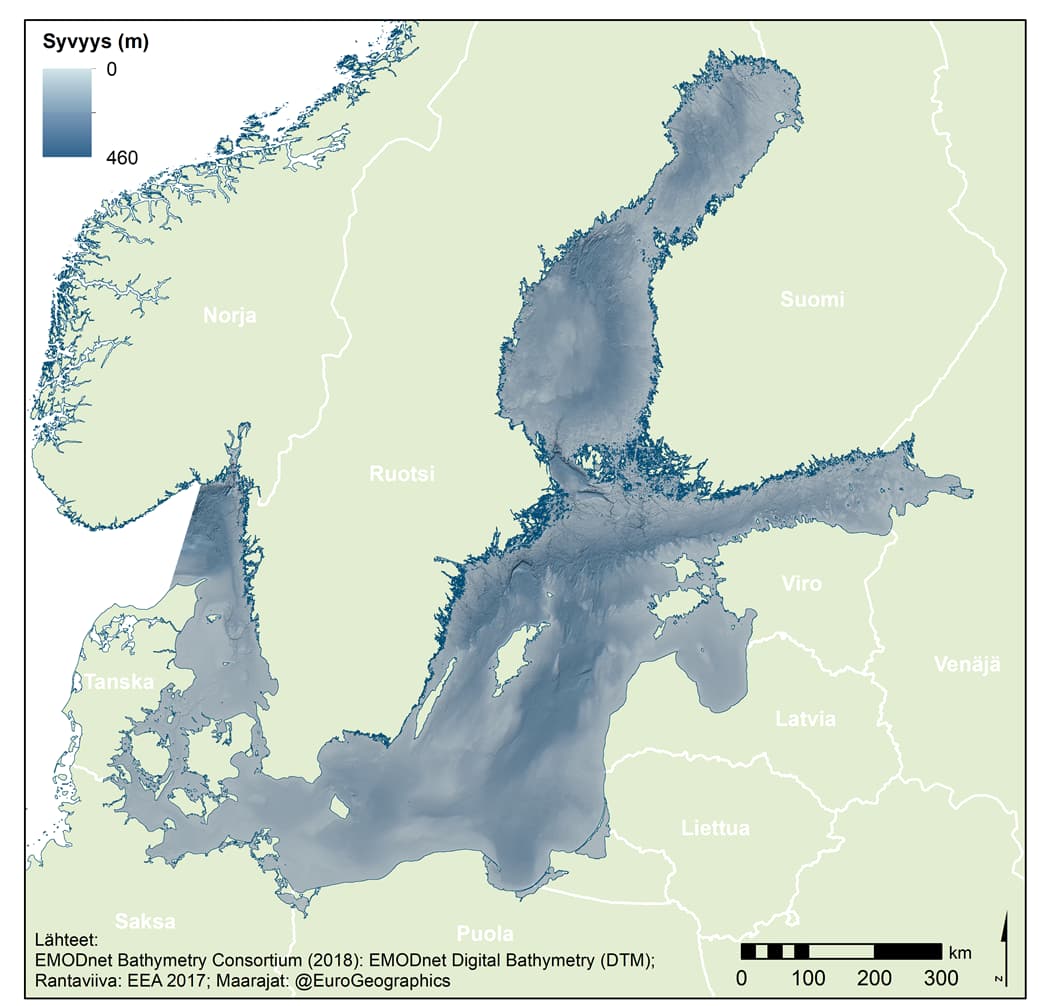
Source; The Baltic Sea in numbers - Marinefinland.fi
Marine Traffic density in the Baltic Sea:

Telecoms Cables in the Baltic Sea:

PS> Water depth were the MV Vezhen crossed the cable from Latvia to Stockholm (via Gotland) is in the deep area to the East of Gotland.
Are You Sir suggesting???..the untinkable??? .
Lets call this time not Dr.Sal ( sorry Professor to ignore your excellency this time ) but may be we call Seymour M. Hersh ??
To explain why CIA and State Dpt fed news outlets suddenly wanted to hush , hush the involvement of the “axis of evil” .
One more thing. Has the mumber of mysterious incidents with anchors increased after russian SMO 240222or immediately after accession of SWE and FIN to Nato??? I am not sure .

Replacing an anchor with spare one takes time even with trained crew.
The spare where carried is generally stored where a crane is required. Anchor work is best carried out in harbour from a small barge that can be positioned under the hawse pipe.
Has anybody looked at the water depth in the short stretch were the main shipping lane from Gulf of Finland to the Great Belt crosses the Latvian cable route near Gotland?
Sorry, I don’t have nautical charts available,
VesselFinder vector map with Vezhen route and waypoint at the time of cable damage (depth in feet; cable shown)

VesselFinder raster map (depth in meters; cable not shown):

Interesting differences between the two maps. The raster map seems to align better with Garmin Navionics whose chart browser is exceptionally buggy today for some reason.
I have looked and water depth varies from abt 200 mtrs to 20 mtrs along the track. See Dr Sal video clip fragment FM Marine Traffic.
I have also found statements FM other users the design of windlass is such , one can not lift more then abt 100 mtrs of chain with anchor attached what is frequently acknowledged by various publications .
Hence damaging of anything at the depth bigger then 100 mtrs is very highly unlikely as then retrieval is impossible unless one navigates to more shallow water facing the risk of breaking the chain and loosing the anchor with part of the chain.
Dragging anchor at depth of 50 is possible on condition the value of the depth is constant along the track. With values less then 50 ( 20- 30) mtr. and fluctuating ,the holding power of chain +. anchor increases dramaticaly under dynamic conditions and may exceed breaking loads of the links. I am sceptical about fluke breaking first with such nice clear cuts and smooth edges.
How about we ask for opinion DEEPSEEK without infuriating Invidia enthusiast ? 
From Sal’s video:

From this Marine Traffic plot she slowed down from 8.3 kts. a few minutes before crossing the Latvian cable to 7,8 kts at crossing and speeded up to 7.9 kts.by the time of the next plot.
Since AIS plots position every few minutes the speed is calculated between plots, not continuously, small speed variation is normal on the display.
Water depth at crossing point; approx. 300 ft. (91.5 m.)
NO sign of any course change at this time.
Wind speed is reported as 20 kts, from 235 degr. (roughly 20 degr. on Stbd, bow)
Not a lot of wind at this time, but not calm. (Bfr. 5)
PS> 8-8.5 kts. is roughly the speed she has had since leaving Gulf of Finland.
Some hrs. later she slows down to an almost stop when reaching shallower waters (<50m.) Did she pick up her anchor during this 1/2 hr.?
I have a few questions:
-
Was this the work (of one or a few) crew members that sneaked up to bow, payed out the anchor at the just the right time and left it hanging at just the right depth to snag the Latvian cable, but avoiding snagging the pipeline and cable that was crossed just minutes before?
-
The OOW didn’t see, hear or notice anything, and the Master knew nothing about it? (No torch light used? No call to get power on the windlass?)
-
When the ship got into shallower waters off Øland Island several hours later the Master become aware that an anchor had been dragged for many miles and (presumably) decided to slow down and come to a stop to recover the anchor?
-
While all this was going on none of the crew noticed anything unusual, nor did the Master think it necessary to report the incident to anybody, incl. Swedish authorities?
Conclusion: Either the Master and all/most of the crew was in on the act, or this ship had no part in the cable break off Gotland.
I don’t buy the idea that this could be done by one/a few rough crew members, nor that the rest would keep their mouth shut about it.
One more question; what is the nationality of the Master and crew on this Maltese registered, Bulgarian owned ship?