I was expecting something that resembled a marine sextant.

On the video one crew member narrates how some navigation data was deleted in error and required some star identification to recover.
I was expecting something that resembled a marine sextant.
On the video one crew member narrates how some navigation data was deleted in error and required some star identification to recover.
Thanks for this gem of a video! In the first half concise and accessible technical explanation without distracting glitzy eye candy, in the second half very likable personal recollections and glimpses at the tension and professionalism involved.
This was James Burke, a BBC science reporter and presenter, who did the best timed TV shot ever.

Yes, I thought Burke’s interviews were at least as interesting as the part about the sextant.
The sextant use was Apollo 8, the interviews were Apollo 11. Found it here:
I remember this video from back when it was first aired on the BBC, the sextant piece is as fascinating now as it was when i first saw it, thanks for putting up the video. I remember James Burke from his reporting on the Apollo missions and covering the first moon landing in 69’. I was only a kid at the time, but he kept me glued to the TV as he has done ever since with his many other presentations, as far as I’m concerned, he’s the David Attenborough of the Science world.
Those are both awesome videos.
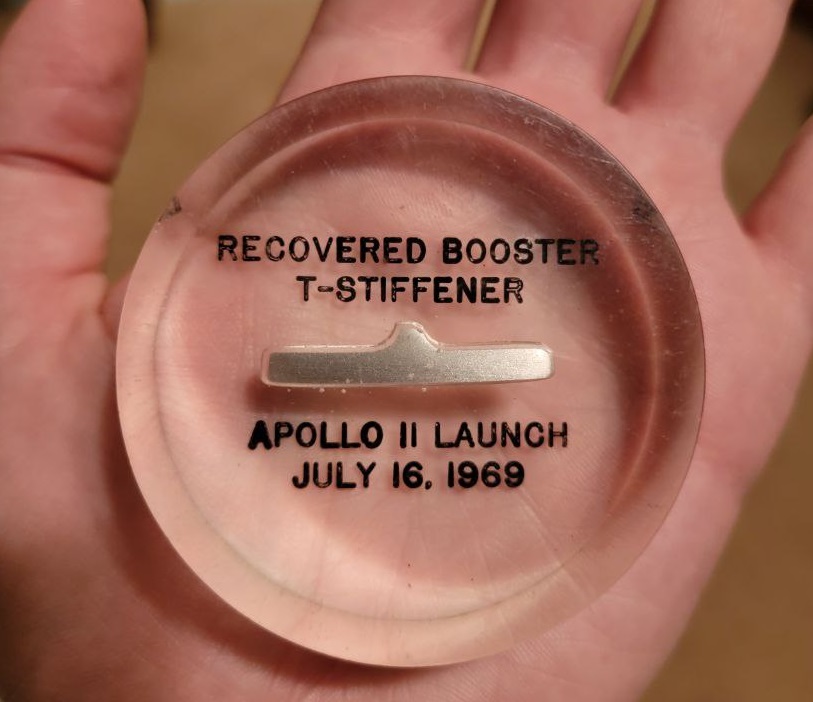
I actually have a piece of the Apollo 11 first stage booster; a “T-stiffener” from the oxidizer tank. One might scratch their chin as to how parts of a booster that was discarded and fell in the ocean far offshore could come to be in a DirtSailor’s possession? I’m glad you asked! The answer is failure to heed Notices to Mariners!
One fine July day in 1969, a German freighter (I believe the MS Vegesack based on my digging) was blithely cruising along, minding its own business (and not minding the NTMs) when out of the blue, flaming rocket parts come raining down all around - and upon! - the vessel. This is generally not considered ideal, and indeed the story I heard was that the captain considered it to be very rude indeed. As I heard it, upon returning to Germany he went straight to the consulate and raised absolute hell.
“Those verdammten Amerikaners dropped flaming rocket parts all over my ship and I demand to lodge a formal complaint!”
You say the Americans did this?
“Ja!”
The Americans who are in the Space Race?
“Ja!”
The Americans who are in the Space Race against those Soviets, right there on the other side of that wall?
“… Ja?”
The Americans who are the only reason those Soviets are not on this side of that wall?
Around this time the captain apparently had a change of heart about filing a complaint.
A few weeks later, a big 'ol crate with “ZUR NASA” or something scrawled in Sharpie on the side shows up on the doorstep at Cape Canaveral. The mission is long since over at the time, Apollo 12 is coming up, and a box of burned up rocket junk has just arrived. What to do? Uhhhh… Send it to the failure analysis lab? See if the nerds there can learn anything from it?
So off the box goes to the failure analysis lab at the Marshall Spaceflight Center in Huntsville, where my granddad was a metallurgist. What he learned is that the parts made for excellent paperweights!
I’ve tried to find more records of the Vegasack, and supposedly there have been articles about the incident written but I haven’t been able to find them. If anybody has any ideas, I’d love to hear.