
Your dirty hands are well deserved. Not quite my path but well respected. Perhaps some young people that visit this site can benefit from your advice.

I thought shipbuilding was difficult today. What a nightmare it had to have been back then. So many things we take for granted.
That’s not accurate. Donald McKay created the extreme clipper ship. He launched the Stag Hound in 1850 and the following year, he built the Flying Cloud which set a record for the passage from NY to San Francisco of 89 days and change. The record stood for 135 years and it took a modern racing sloop to beat it. The building frenzy to meet the demand for speed at any cost was short lived. By the mid 1860s, iron fittings started to be used allowing for larger ships to carry more cargo and the era of the pure race horses of the seas, the classic all wood extreme Yankee Clippers was over.

The Flying Cloud
Before those Clippers were the Baltimore Clippers. This book is a fascinating read: https://www.amazon.com/Pride-Sea-Courage-Disaster-Survival-ebook/dp/B07MKP29YG/ref=sr_1_1?dchild=1&keywords=Pride+of+Baltimore&qid=1590710027&sr=8-1
I always knew the old ships were not as safe as a modern ship, but even when brand new they were considered extremely dangerous. They were essentially high strung racing yachts more than a cargo ship and they really only paid when doing something illegal or later on high value speed sensitive cargo.
One of the reasons the Pride sank was they were quite undermanned compared to her original sisterships, the manpower needed to operate them was a lot more than a much bigger slowpoke “tub”.
The same spirit that drove the prohibition rum runner launches and moonshine runners in their souped up Ford Coupes. The need for speed.
No doubt.
In the early 1800’s the Hudson River in New York had some of the most beautiful day liners connecting NYC to Albany, NY. Albany was the eastern terminus of New York’s Erie Canal. The western terminus was at Buffalo, NY where it joined Lake Erie (of the Great Lakes)
In time steam powered towing boats would be built to pull flotillas of canal boats over to Cleveland, Ohio which was the northern terminus of Ohio’s Erie Canal. The southern terminus was at Portsmouth, Ohio. (this opened in 1835) At this time one could arrive in NYC and travel to New Orleans in 30 days all on water.

Canal boats were not powered but pulled along by draft animals. There were experiments with propelled canal boats but it wasn’t adopted. (although some concepts were quite interesting)
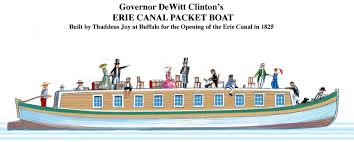
This is what connected (and other Canals in the USA) early America together with a mass/bulk transportation system. It brought New York City to the forefront as the leading center of enterprise in the USA where before Boston, Baltimore, and Philadelphia
were the foremost of American Cities. Later the Miami Canal ran from Toledo Ohio on Lake Erie to Cincinnati Ohio on the Ohio River. Cincinnati became known as the Hub City as it was in the center of 3/4 of America’s population at that time and it’s transportation radiated out like spokes in a wheel…
To develop the thought on canal boats, some were quite lovely. Generally there were four classes of canal boats. Passenger, Livery, Freight, and Mixed, with the Passenger types being the most opulent. The tow path beside the canal where a team of draft animals were used to tow the boats were manned by young boys or men referred to as “Hoagies”. they commonly walked 15 miles a day. 7.5 miles out and turn around and walk 7.5 miles back.
Pete Seeger sings 15 miles on the Erie Canal
It is surprising to most Europeans who visit the USA that those here only see the Great Lakes as a recreation area. They see it as an inland ocean with so much more potential
than it is used for. Our ancestors realized the enormous potential of the agricultural, and industrial engine of the mid Atlantic States and mid Western States and sought to connect these areas to the Atlantic coast thru a network of canals linked to the Great Lakes. Today it has led to numerous International Inland Ports. (Columbus, Ohio having entered this league since the mid 90’s) But in the time of the canals it brought New York
to the status of brokering America’s national production to the rest of the world.
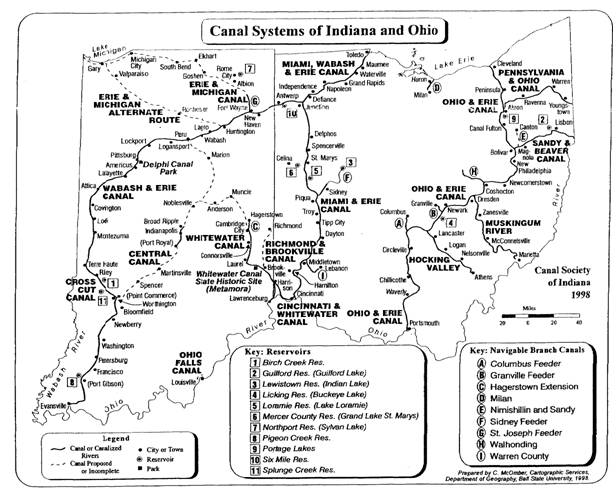
Here you can see Ohio and Indiana’s canal system.
Pennsylvania and New York also had elaborate canal systems.
This also enhanced trade with Canada and brought high quality iron ore to America.
But by 1850, railroads were beginning to be built and for awhile they worked with the canal
trade. But in time as more track was laid the railroads proved faster and less vulenerable to floods. Floods all but wiped out the Ohio Erie Canal in the Scioto Valley near Portsmouth, Ohio. 1925 was about the last of operations of Ohio’s Erie Canal.
But this “Inland Ocean”, the Great Lakes…did so much in building America east of the Mississippi River.
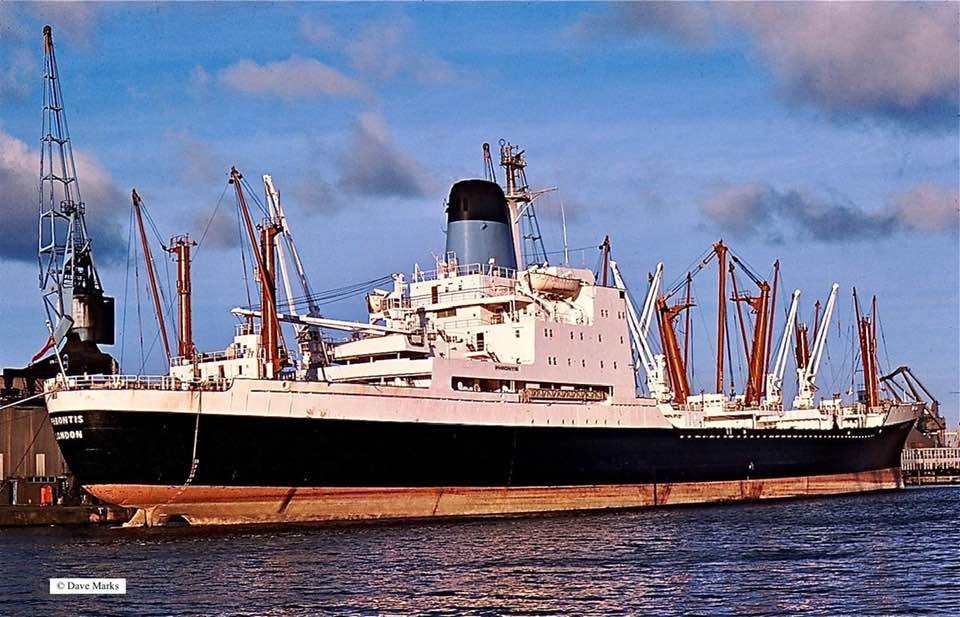

One of the BI ships, the Sirdhana, blt. 1947:


Completed December 1947
Passengers: 21 x 1st class, 32 x 2nd class, 30 intermediate class, 333 bunked & 987 deck
Passenger accommodation modified 1955
(original passenger capacity 21 x 1st class, 70 x 2nd class, 2,355 deck)
PS> My Father-in-Law sailed for BI until he came ashore in 1968 to become Cargo Surveyor. Eventually started his own company Still living in Singapore at age 94 (soon 95)
A New Zealand friend of mine was a cadet in BI and was involved in the incident with the cannon at Muscat if my memory is correct. I’m sure that your father in law would remember it.
As far as he remember anything at 94. I’ll ask when I get back to Singapore next. (Meanwhile maybe I can google it?)
I googled it with no result.
Not lines, but when ships had Doxford engines:

I sailed on three ships with Doxford. Two had nothing but problems. (Both Tankers) The third? No Problems. (WW cargo liner)
PS> All three built abound 1950. (Two on Tyne side, one in R’dam)
That’s a very posh Doxford. The LB, as I’m sure you know, has hoses to supply cooling water to the upper pistons and swinging links to supply it to the lower piston. You knew a hose was leaking when you had a shower and you knew a swinging link was leaking when the sump level rose and the cooling water tank level dropped. I sailed on an LB, as the 8-12 watch keeper, when in the last few months of my apprenticeship and loved every minute of it!
Don’t know that amount of details of the Doxford engines.
I was Deckboy on the first tanker. (Scavenger fires)
OS on the WW Cargo liner (No problems)
I was Capt. on the second tanker. (All kinds of problems)
I remember especially coming through Hormuz Strait fully loaded when the engine died. We were drifting in the middle of all that traffic (luckily it was daylight) and getting closer and closer to the Islands on the Omani side.
PS> this was before the traffic separation so we used the shortest route, between the Omani Islands.
I sent the Mate fwrd to get the anchors ready and kept on calling the Chief about when he would be able to start the ol’ Doxford again, “Never, if you don’t stop calling all the time”.
He got it going just before I was ready to sacrifice two anchors to stop us from drifting onto the steep cliffs on the island.
We were in the Inland Sea (I think it is called) off Japan and the Old Man made it very clear that we were not allowed to stop for any reason. Unfortunately a hose not only leaked but parted and as there were no isolating valves on each cylinder we had to stop. Mind you I think we had the new hose on in very short order, having prepared all the kit while the leak was worsening.
Somehow I’ve always found large exposed moving masses such as the reciprocating top cylinders of Doxford engines dangerously captivating. A rotating shaft does not induce the same kind of “I wonder what would happen if I put my hand in there just a little bit…” thought…
Back in the day our minesweepers had triple expansion steam engines as did our river class frigate that had been converted to hydrographic duties. The engineer officer and chiefs used to check the temps of the bottom end bearings by putting their hand down there. The minesweepers had inward turning screws which meant that standing between the engines one got coated with a fine mist of the emulsion of oil and water from the open crankshafts.