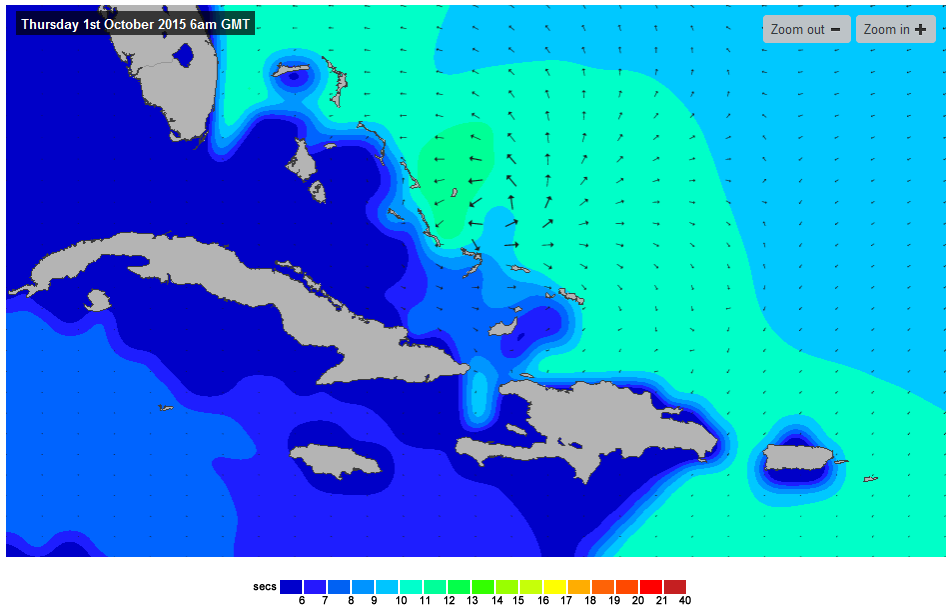
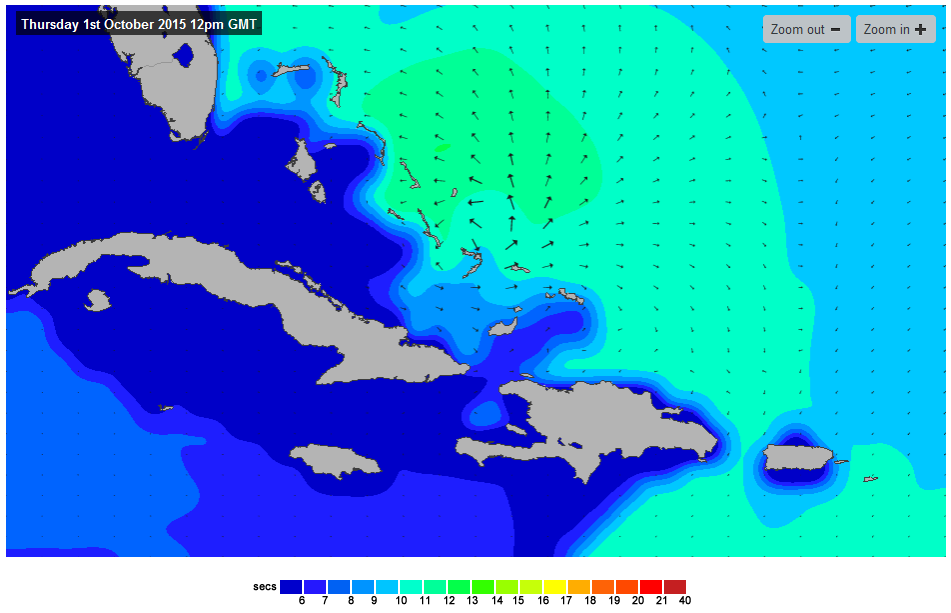
Can anyone interpret these wave period maps?
Graphics from Magicseaweed.com
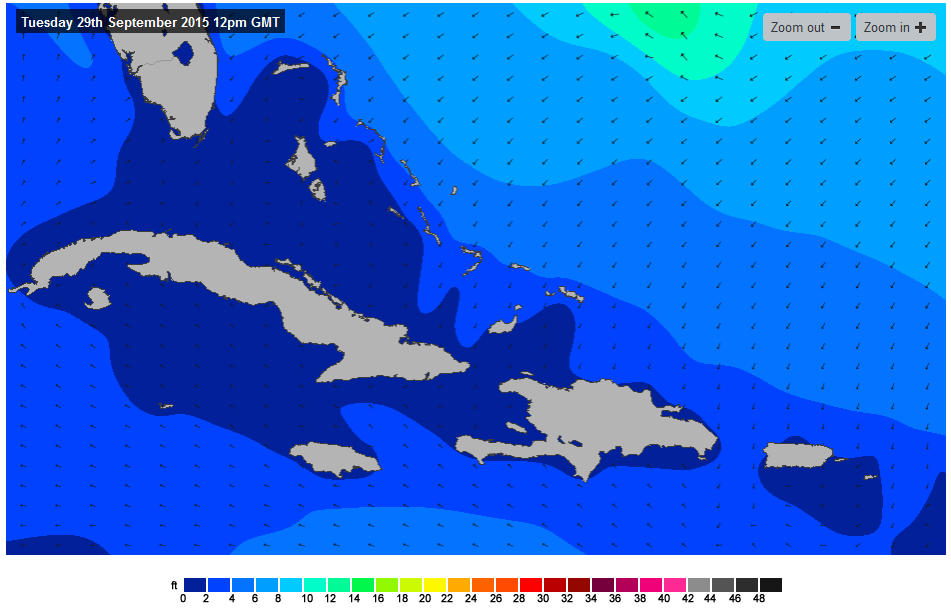
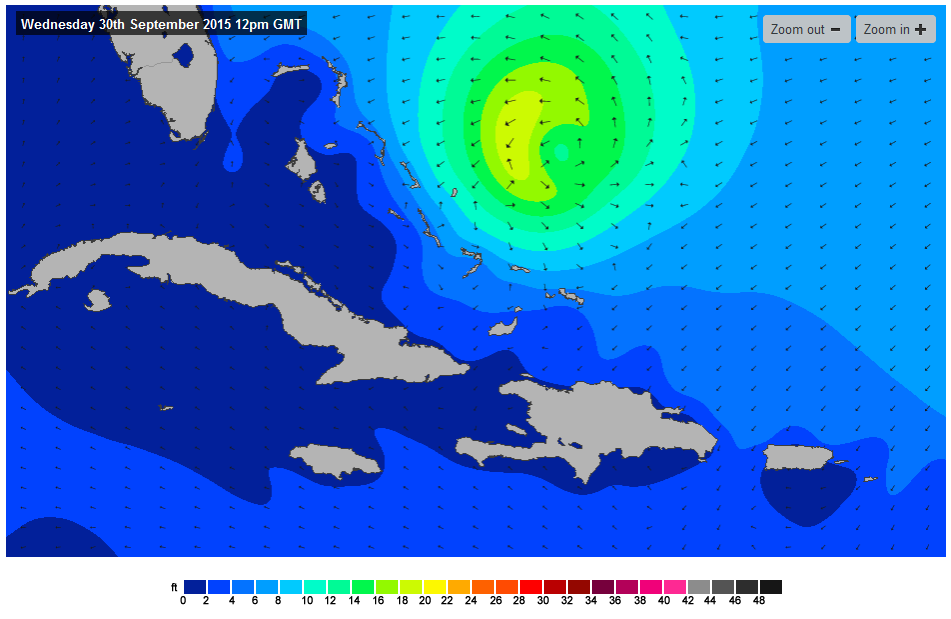
The following three wave height maps illustrate again the extreme nature of the change in sea conditions over the crucial 48 hr time period.
The last map shows how on the W side of the eye the seas were a mess, converging at right angles, the sort of conditions which would pile up wave trains onto each other to form massive pyramid type waves.
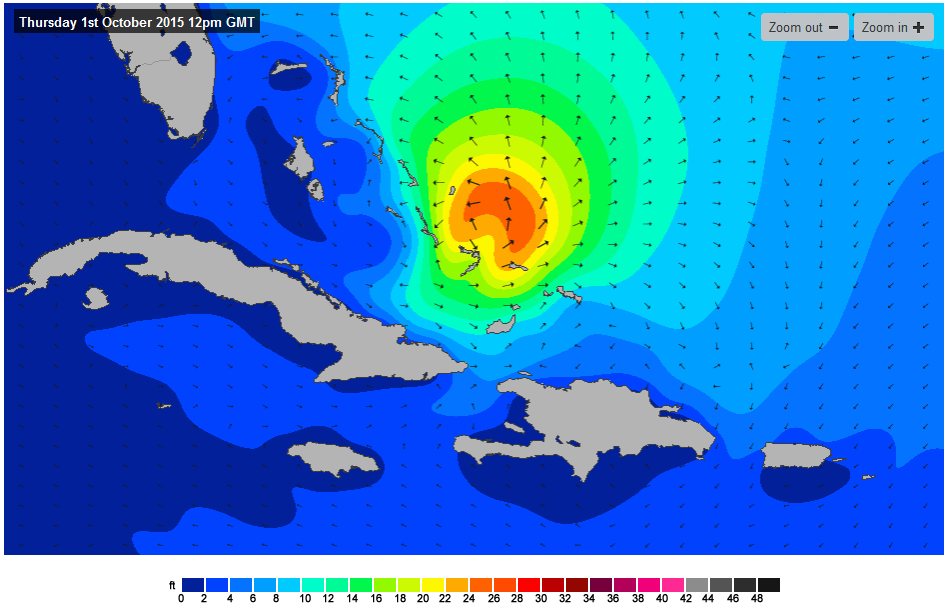
Graphics from MagicSeaweed.com
I’m listening to the live feed. CG officer involved in the search and rescue discussing the attempt to recover the remains found in a gumby suit. Gruesome. Remains too degraded by warm water decomp to identify so they placed a marker beacon on the body and went to investigate a report of another suit sighting (which did not pan out). They returned to retrieve the remains and couldn’t find them. Said the beacon failed to activate.
Somewhere out there floats a gumby suit with remains in them.
[QUOTE=Mat;179870]Can anyone interpret these wave period maps?[/QUOTE]
The NWS charts I see use numbers not colors, this one is a little hard to read. Looks like Crocked Island on the 12 pm chart is at 11 sec? The arrows must be swell direction and height.
With regards to the periods and the ship’s rolling period, I wouldn’t be confident coming to any conclusions, I expected the periods to be shorter. Having said that, in my experience a ship DIW with a 15 sec rolling period in a 11 sec sea would not be likely to experience synchronous rolling. If the ship’s period was a bit less, or the sea a bit longer, it’d probably start syncing up more and more often.
Maybe this table is helpful for the interpretation of the wave period maps. The L/H column is an indication for the steepness of the waves.
everybody here already knows that I don’t hold Workboat magazine in very high esteem however I must say that I do like this Kirk Moore (who isn’t even a professional mariner. btw)
Kirk Moore
2/23/2016
For anyone working on the water, the first week of Coast Guard board of inquiry hearings into the El Faro disaster carried the twin weights of discovery, and a sad familiarity.
The threads of the story are emerging: propulsion failure on the 790’ ro/ro containership enroute to Puerto Rico, a dodgy hurricane that caught up to the ship, a captain and crew of 33 who in a last communication to shore still had hopes of saving it.
The U.S. maritime community takes a hit like this roughly every decade. There was the Marine Electric sinking off Virginia in February 1983, with the loss of 31 lives. Writer Robert Frump, who ran down the facts of that disaster, is on the case now in Jacksonville, Fla., covering the El Faro hearingwith a keen eye to what it could mean for the straining U.S. industry.
In January 1999, it was the loss of four commercial shellfish boats and 11 crew within days of each other in the Northeast that brought the Coast Guard to commission a commercial fishing vessel safety task force. As we are seeing with the El Faro inquiry, there were long days of testimony on exacting technical details related to each accident.
Seemingly commonsense practices on those boats – opening hatches for ventilation, using sea water in clam holds as ballast – were shown to be fatal mistakes. Free surface effect – the momentum of water rolling in the holds – and downflooding through hatches were implicated.
A package of reformed safety rules for the commercial fishing industry came out of, that process – as had happened almost exactly a decade before, when in 1988 Congress passed a commercial fishing safety law. Safety experts said it did not go far enough – as they had said in 1988.
Another decade went by, and in March 2009 six fishermen were lost when their scallop boat Lady Mary sank off New Jersey. That inspired another punch list of 45 steps the Coast Guard recommended to make the industry safer.
The Lady Mary investigation was chaired by then-Cmdr. Kyle McAvoy, who has appeared again at the El Faro hearings. Capt. McAvoy, who now heads the Coast Guard’s vessel inspection program, testified Monday that El Faro was marked as having a higher “potential for risk” given its 40-year age and other factors.
Without the ship’s voyage data recorder, still lost 15,000’ down, the board can only reconstruct what might have happened in El Faro’s last hours. Saturday’s testimony about captain Michael Davidson’s last call to shore, when he said he had a plan to pump out a flooded hold, indicated that while he had lost propulsion, there was still power. When the board completes its best effort to present likely technical factors in the sinking, the fact will remain that El Faro’s voyage depended on beating a hurricane before they crossed paths. That human factor may mean “we won’t learn anything,” as Mario Vittone wrote in his October 2015 column in gCaptain:
“Otherwise good people, with all the information they needed to make a good decision, made a bad one.”
[QUOTE=Mat;179870]Can anyone interpret these wave period maps?
[/QUOTE]
It is doubtful whether all the theories about waves, wind and fetch are still valid near the eye of a hurricane. The known tables are for normal storms in the open sea up to force 11 and with the necessary fetch.
With hurricanes, near the eyes, we deal with “Force 24+” and with quasi no fetch. Maybe there are other wave creating physical phenomenons.
Around a static hurricane, the winds are near circular, while the waves propagate always in a straight, tangent way, all over 360° around, with diminishing wind forces and changing wind directions further away.
Real hurricanes are not static; they advance (Joaquin at about 6 knots). The waves forward with the hurricane’s move are faster than the hurricane and cannot become higher, but all other waves in front of the hurricane receive strong winds from ever changing directions… a horrible sea on the right front of the hurricane with these multi-cross waves.
I never heard of mathematical models describing what will arrive; and on ships in this situation, they may have others than scientific interests. Only aircrafts may return with radar pictures to describe the real state of the sea near the eye, and that just for a given hurricane at a given place and at a given time.
This is the timeline:
Tues., Sept. 29 – El Faro departs Jacksonville at 8:10pm EST for Puerto Rico with 33 aboard.
Thur., Oct. 1 – 7:20am – El Faro’s last communication. The Captain reported:
Vessel had lost propulsion.
Vessel experienced water ingress into a cargo hold through a scuttle (small opening to allow crew access into a hold).
Crew had secured the scuttle and was successfully pumping out the water from the hold.
Vessel was experiencing a 15 degree list but it was unknown whether it was a result of water ingress or the weather conditions.
The operator then transferred the call to Lawrence, who had been trying to dial back to the captain. That part of the call on Lawrence’s cell was not recorded, but he recounted it to the Coast Guard board from his notes.
“Once I was connected to Captain Davidson he said, ‘We’ve secured the source of water,’” Lawrence said. “He told me the crew was safe.”
Lawrence asked for the ship’s position, and heard Davidson speaking with a female crew member, probably second mate Danielle Randolph.
“She also spoke in a very calm voice, and said there were 48 miles east of San Salvador” in the Bahamas, Lawrence said.
Davidson said he thought the crew would be able to pump out the No. 3 hold, Lawrence said.
“He told me, ‘No one’s panicking,’” Lawrence said. Davidson described conditions with wind from the northeast and 10’ to 12’ swells.
“What kind of list are you talking about, Cap?’ Lawrence asked. Davidson replied it was about 15 degrees.
Davidson told Lawrence “he would push all his buttons” to initiate distress signals, Lawrence said he would notify the Coast Guard, and the men ended the call.
Coast Guard investigator Keith Fawcett asked Lawrence how he assessed the situation after that call, and Lawrence said Davidson’s and Randolph’s calmness sounded like they had the situation in hand.
“I honestly felt that…he won’t have that list any longer,” Lawrence said of Davidson’s plan to pump the hold. “He would get his engines back and get underway. I expected to talk to him further.”
Have we learned any essentials from the hearings so far? In my humble opinion nothing-nada-zero. Of interest further on in the week could be the questioning of Mr. Bryan Vagts El Faro Chief Mate TSI and Mr. Jamie Torres Chief Mate TSI on the subject of ‘Cargo loading, general calculations of stability and securing of cargo and C/M duties at sea.’
For the NTSB investigation later on the availability of the S-VDR data would be very beneficial. The big question however is if the equipment is found after all and in what condition will it be.
Mandatory S-VDR Signals
• Data & Time (GPS)
• Latitude & Longitude (GPS)
• Speed (Speed log)
• Heading (Gyro)
• Bridge & VHF Audio
• Main Radar (substitute AIS if Radar is impossible to record)
If NMEA Serial output is available (IEC 61162):
• Depth beneath the keel
The last value we know in the mean time…
Most important is the bridge conversation as recorded from the four microphones installed in the bridge’s ceiling. Pictures of the radar screen could also be important. They were so close to the eye of the hurricane that one would expect it to see it on the screen. A change in the picture could indicate the time that the list took place. The moment that the picture went suddenly black would indicate the time of the loss of power or the roll over. Is anybody familiar with the make and type of the ship’s radars?
One would wish that bridge video pictures were also available. Why not install something like an outdoor GoPro with window wiper on the top deck looking forward or just on the bridge behind a window. With those fish eye lenses you have a terrible wide picture. Most cars these days carry dashboard camera’s, why not a ship? Any number of these cheap devices could be placed on different strategic positions. That could provide us in case of accidents with valuables additional information. Maybe something for the future. Big brother…
[QUOTE=Dutchie;179887]Have we learned any essentials from the hearings so far? In my humble opinion nothing-nada-zero. Of interest further on in the week could be the questioning of Mr. Bryan Vagts El Faro Chief Mate TSI and Mr. Jamie Torres Chief Mate TSI on the subject of ‘Cargo loading, general calculations of stability and securing of cargo and C/M duties at sea.’
For the NTSB investigation later on the availability of the S-VDR data would be very beneficial. The big question however is if the equipment is found after all and in what condition will it be.
Mandatory S-VDR Signals
• Data & Time (GPS)
• Latitude & Longitude (GPS)
• Speed (Speed log)
• Heading (Gyro)
• Bridge & VHF Audio
• Main Radar (substitute AIS if Radar is impossible to record)
If NMEA Serial output is available (IEC 61162):
• Depth beneath the keel
The last value we know in the mean time…
Most important is the bridge conversation as recorded from the four microphones installed in the bridge’s ceiling. Pictures of the radar screen could also be important. They were so close to the eye of the hurricane that one would expect it to see it on the screen. A change in the picture could indicate the time that the list took place. The moment that the picture went suddenly black would indicate the time of the loss of power or the roll over. Is anybody familiar with the make and type of the ship’s radars?
[/QUOTE]
You must be watching a different hearing than I am. The presentation of the mate’s texts with the Master, the recorded conversations and record of the conversation between DPA, Master, and CG, and especially the email from Master to DPA have all been incredibly informative and essential.
The net sum of these bits of info paint a picture of a Master executing a sailing plan, had awareness of the weather situation and was adapting to it based on his assessments of impacts, who did make changes in course without permission (but was checking in for future plans) and was-- according to the CG SAR commander–the only vessel within–what, 150 miles of the position in which he ended up? The sea is vast and sure you don’t see many folks out there, but c’mon, it’s not that far from shipping areas and if you’re the only one out there… When one carefully considers the state of information available pre-sailing and during the voyage, it doesn’t support a commercial pressure forcing a master to sail so much as a master who pressed on vice backing off (admittedly another form of commercial pressure, but, a different set of considerations would be influencing the master–given his decision to sail, possibly ego, and devaluing what was going on around him as ‘safe’ up until it wasn’t). C-Captain’s play of the forecasted tracks is good, but it should include the one from before the master sailed, which probably provided a more rosy future, and impetus to go. This guy presents a good layout, when overlaid with the timing of the texts and emails, I think it is compelling. http://www.themaritimesite.com/el-faro-captains-negligent-decision-joaquin/ ( Apologies if this link has already been posted, and I do not endorse by posting such link any determination or use of the word ‘negligent’–that’s for the blue-suiters and attorneys. )
The remaining issues are a cataloging of pre and post ‘Man and His Technology versus Nature’ considerations. These are important fields of investigation and I have maintained that from the beginning, but, I would definitely not characterize the state of knowledge thus far out of the proceedings as ‘nada’.
With regards to the possibility of a deep roll in relatively low seas this is from gcaptain: WATCH Massive Containership Take 40 Degree Rolls in North Atlantic WATCH
Here is the forum thread about it: Why the Roll?
This is what I wrote.
Looks like synchronous rolling from a long, heavy swell from the quarter.
It’s tricky to deal with this situation because you can sail for hours with little rolling and then take a series of heavy rolls. Because of the ship’s speed and relative swell direction, small changes in the wave period result in large changes in the ship’s behavior. If a less then major course change is made it might not help because the rolling will then occur with a different set of swell
The rolling can usually be stopped by a slight course change till that particular set passes then return to orginal course. Sometimes just putting the rudder over is enough to break the roll momentum. Problem is that often the bridge watch doesn’t realize that the ship is rolling synchronously until about the third roll. Even then mariners who have never encounted this type of rolling are left not knowing what to do. Even if they know it still takes fairly good sea-sense to accomplish. I"ve known some very experienced mariners to get in trouble this way.
The other posters mentioned parametric rolling but the swell period is too long for that.
[QUOTE=Kennebec Captain;179889]With regards to the possibility of a deep roll in relatively low seas this is from gcaptain: WATCH Massive Containership Take 40 Degree Rolls in North Atlantic WATCH
Here is the forum thread about it: Why the Roll?
This is what I wrote.
The other posters mentioned parametric rolling but the swell period is too long for that.[/QUOTE]
I think the discussion of roll periods is academic. Looking at the track of vessel and hurricane, isnt it more likely that the passage of the eye and shift in winds/seas on a vessel not under command with water in a hold, marginal intact stability to say nothing of damage stability and a list induced by wind to some degree suddenly found the situation reversing with possibly immediate, disastrous effects?
Close to the center of a very strong cyclonic system the seas would likely be chaotic and very little if anything to be learned looking at wave periods.
However in my view this incident has two parts; before the call and after the call.
The evidence suggests that before the call the ship was not in heavy seas when the scuttle was blown open and the propulsion failed. The report from the captain to the DPA was:
Lawrence said. Davidson described conditions with wind from the northeast and 10’ to 12’ swells.
This was after the ship lost propulsion and had a 15 degree list.
If the ship was in 30 foot seas and rolling heavily at the time of the call it seems likely the captain would have reported that rather then saying he was in 10 to 12 foot seas with a 15 degree list.
As far what happened after the call when the system passed over the 40 year old ship, aside from satisfying curiosity, likely little to be gained by learning the exact failure path.
EDIT:
This chart supports the possibility that there was an area of 10-12 foot seas close to center of Joaquin.
[QUOTE=Jamesbrown;179891]I think the discussion of roll periods is academic. Looking at the track of vessel and hurricane, isnt it more likely that the passage of the eye and shift in winds/seas on a vessel not under command with water in a hold, marginal intact stability to say nothing of damage stability and a list induced by wind to some degree suddenly found the situation reversing with possibly immediate, disastrous effects?[/QUOTE]
continuing this discussion of the “reported” sea state is a red herring whether it was so low or was in fact much worse
this much we know at the time of the first call
this is what we know from the second call with the call center
obviously from the change in the master’s tone of voice we can summize that the situation has deteriorated significantly and he feels real fear for the ship.
the unrecorded conversation between Davidson and Lawrence can only be taken at face value because we do not have a recording of that but we can gather what little we can such as
here is what is “my” assessment of the desperate situation found itself
the error chain is simple…take a ship too close to a strong storm and you place it at risk to something catastrophic occurring which it did. Take away the propulsion failure and the EL FARO lives but so close to a strong hurricane and the ship was likely doomed to die if propulsion is lost for any length of time (“the clock is ticking”). The lashings of the cargo could not take the snapping which was likely happening to them. Once the lashings were lost on even one trailer, so was the ship. anyway this is my assessment and the cause of the loss. It is quite possible we will never truly know what cause the EL FARO to die like with the POET’s loss in 1980.
.
[QUOTE=c.captain;179897] Lashings cannot hold forever in such conditions. Something was bound to fail.
2. rogue waves exist and a particularly big rogue was a very real possibility which could have layed her right onto her beams end
3. the end came fast because there was no distress call made
the error chain is simple…take a ship too close to a strong storm and you place it at risk to something catastrophic occurring which it did. Take away the propulsion failure and you EL FARO lives but so close to a strong hurricane and the ship was likely doomed to die. The lashings of the cargo could not take the strain. Once the lashings were lost, so was the ship.[/QUOTE]
Those barrel lashings are bad to begin with. I had some experience with cargo breaking loose with them. As the ship rolls the the binders get tight and then get slack. The binder itself begins to unscrew and back off, allowing more slack for the cargo to move. Rather quickly, the cargo can move with with enough force to snap the chain. In my case to get the cargo secured again, I had to scream at the captain “Turn in to the wind and slow the fuck down!”.
[QUOTE=Kennebec Captain;179892]This chart supports the possibility that there was an area of 10-12 foot seas close to center of Joaquin.[/QUOTE]
what difference does it make though? A map showing small seas does not excuse Davidson’s decision of taking his ship into such a close proximity to a strong hurricane is VERY DANGEROUS and FILLED WITH POTENTIAL PERIL. Nobody can predict what will occur when we make a decision but before any decision is made, the POTENTIAL OF A CATASTROPHIC EVENT happening must be considered!
I keep relating my own mistake of taking the GALAXY into a situation where I FAILED to consider the potential for something catastrophic happening and IT WAS ONLY LUCK that it didn’t. Had an engine or steering gear shut down on her that night, I firmly believe she would have fallen into the trough and rolled over. There would have been no survivors and it WOULD HAVE BEEN MY OWN FAULT! The USCG would have held hearings where my decisions were all called into question and the maritime community would have roundly condemned my decision to go past Cape Spencer into a forecast strong storm. In my case, I did NOT even have a reason for doing so. No office telling me to be in Dutch on a given date. No clients waiting for their cargo. NOTHING OTHER THAN MY OWN LACK OF EXPERIENCE (it was the winter of 1990 and I was only 28, only having sailed as a master for little more than a year) AND LACK OF APPRECIATION FOR THE POWER OF THE SEA!
When it was over and I realized the danger I had FOOLISHLY placed the ship and her people in, I became much wiser and cautious in how I made my command decisions from that moment forward. Was Davidson somehow not a wise master even though he was in his 50’s? Something we all must consider here… I recall that in the original tread after EL FARO disappearing that I made a comment on whether the master was too young to be in his position and was surprised when it was disclosed what his age was. I really was believing from my own experience that Davidson had made that same grievous error of judgement I had made but that could only happen to a young man who had not been learned. To make such a rookie mistake so late in one’s career is hard to fathom. Afterall, Davidson had sailed in the Gulf of Alaska in the winter I believe on tankers so he would know how the sea can take a big and sound ship and knock it right into the gutter.
I am feeling myself knocked into the gutter all over again…it is a terrible feeling! My guts are twisted into knots!
.
Chester Nimitz was a TRUE SEAMAN who understood
In conclusion, both seniors and juniors alike must realize that in bad weather, as in most other situations, safety and fatal hazard are not separated by any sharp boundary line, but shade gradually from one into the other. There is no little red light which is going to flash on and inform commanding officers or higher commanders that from then on there is extreme danger from the weather, and that measures for ships’ safety must now take precedence over further efforts to keep up with the formation or to execute the assigned task. This time will always be a matter of personal judgment. Naturally no commander is going to cut thin the margin between staying afloat and foundering, but he may nevertheless unwittingly pass the danger point even though no ship is yet in extremis. Ships that keep on going as long as the severity of wind and sea has not yet come close to capsizing them or breaking them in two, may nevertheless become helpless to avoid these catastrophes later if things get worse. By then they may be unable to steer any heading but in the trough of the sea, or may have their steering control, lighting , communications, and main propulsion disabled, or may be helpless to secure things on deck or to jettison topside weights. The time for taking all measures for a ship’s safety is while still able to do so. Nothing is more dangerous than for a seaman to be grudging in taking precautions lest they turn out to have been unnecessary. Safety at sea for a thousand years has depended on exactly the opposite philosophy.
I actually revere Nimitz much more than Halsey…it is only the colorfulness of the latter that makes me use him as my go to guy when it comes to the modern US Navy. Chester Nimitz was the far more wise of the two.
[QUOTE=Jamesbrown;179888]…was-- according to the CG SAR commander–the only vessel within–what, 150 miles of the position in which he ended up…[/QUOTE]
In the hearing today he mentioned having been in touch with the Emerald Express, which had been within about 25 nm of El Faro. That vessel had heard some of El Faro’s radio broadcasts, and one crew member even stated that he heard El Faro announce that the crew was abandoning ship. Emerald Express was lucky in that it was washed into the mangroves on Crooked Island, and suffered no casualties.
https://www.vesselfinder.com/news/4713-Video-The-Emerald-Express-caught-at-sea-in-Hurricane-Joaquin-and-then-beached-on-Crooked-Island
http://www.wokv.com/news/news/local/coast-guard-knew-el-faro-was-serious-trouble-first/nqW2X/
[QUOTE=Mat;179909]In the hearing today he mentioned having been in touch with the Emerald Express, which had been within about 25 nm of El Faro. That vessel had heard some of El Faro’s radio broadcasts, and one crew member even stated that he heard El Faro announce that the crew was abandoning ship. Emerald Express was lucky in that it was washed into the mangroves on Crooked Island, and suffered no casualties.
http://www.wokv.com/news/news/local/coast-guard-knew-el-faro-was-serious-trouble-first/nqW2X/[/QUOTE]
So, the Master of that ‘vessel’ ended up aground, with damage and was not far, far far away from EL FARO?
Well, I take back any implications that the absence of a large proportion of vessels in the vicinty by a wide margin of area–presumably due to cautious mariners being in command–as a sign of any lack of prudence on the part of the Master of EL FARO.
Then again… maybe I don’t. The 150 nm figure was from searching for vessels to render assistance, obviously and as noted in testimony, the EMERELD EXPRESS could not. Still a telling factor, don’t you think?
[QUOTE=Jamesbrown;179913]Well, I take back any implications that the absence of a large proportion of vessels in the vicinty by a wide margin of area–presumably due to cautious mariners being in command–as a sign of any lack of prudence on the part of the Master of EL FARO. [/QUOTE]
I can attest to the loneliness of being the only one out in the shit and yes, it points to a major failure when you are there because when so many others deem the conditions not safe for navigation, it is tantamount to saying “WHAT THE FUCK ARE YOU DOING OUT THERE WHERE YOU ARE?”
This is now pointing to a greater and greater degree of human error and less like TOTE was culpable…but then that is very likely what they are maneuvering for us all to believe? Frankly, I am having a hard time knowing what the believe anymore other than that Davidson failed to obey the tenants to put the safety of his ship and her people ahead of all other considerations. REGARDLESS OF TOTE, HE HAD THE POWER TO STOP BUT DID NOT EXERCISE IT.
this is bad…I mean really bad to contemplate right now. This is that KLM 747 at Tenerife
.
