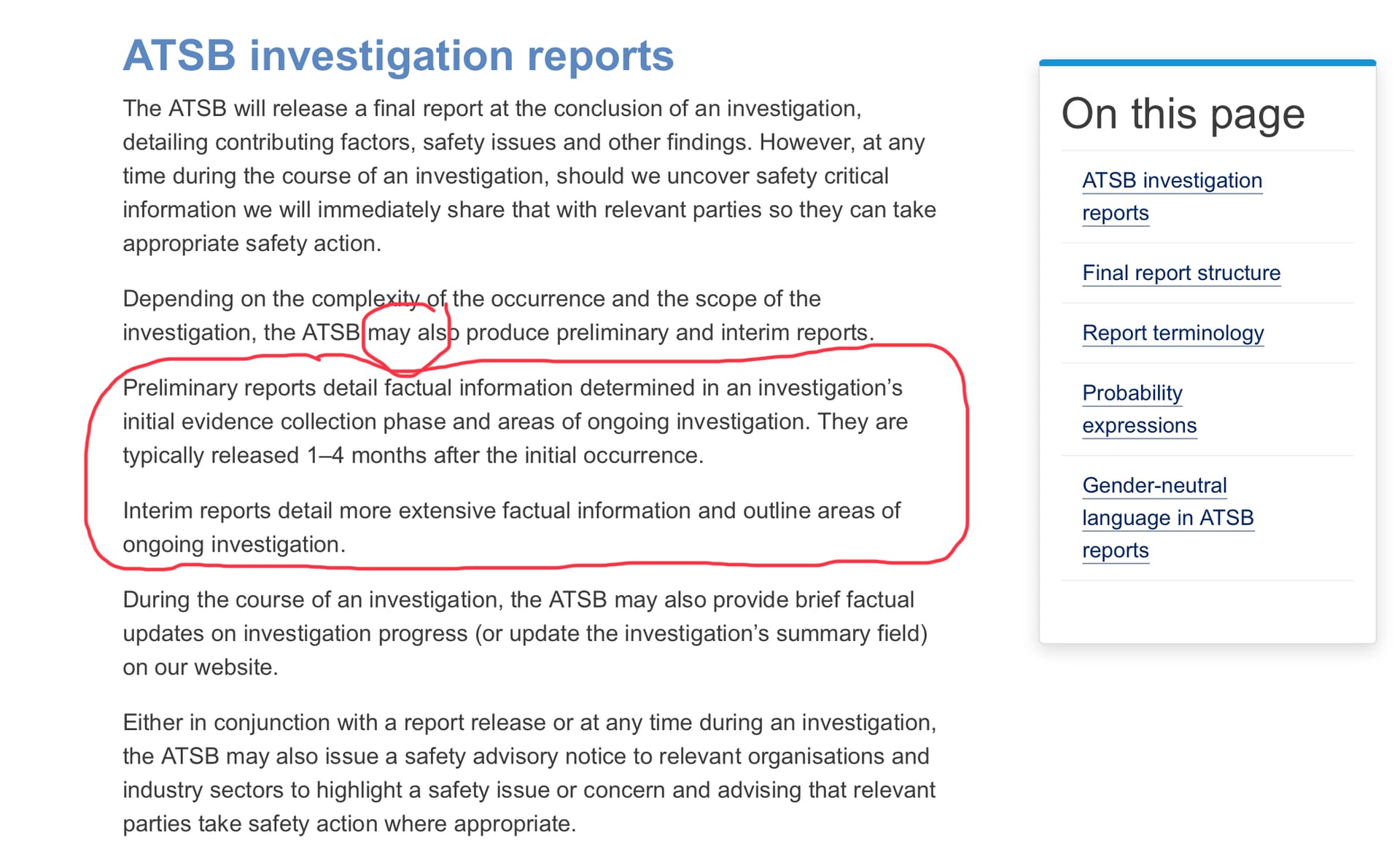
Here is the interim report undertaken by the ATSB on the “Maersk Shekou”. 20 pages with plenty of detail. The ATSB only covers Marine, Aviation and Rail.
The NTSB cover Marine, Aviation, Highway, Pipeline and hazardous materials during transportation. That is a lot to cover with limited resources.
Has there ever been consideration towards splitting Marine, Aviation and Rail off to a separate authority?
And being a Mexican training ship, I wouldn’t be surprised if it was a cadet in the engine room following commands to the best of their abilities to all of this.
The turn around for the ATSB interim report is impressive. About 8 days. It’s also mostly facts without reaching any root cause or conclusions yet. Great formatting though.
Therein lies the answer. As a professional Mariner I don’t need the ATSB to provide root cause within this interim report. There is sufficient detail to easily derive the various (yes, plural) causations.
The docking pilot gave astern commands to the captain on the conning deck, which were acknowledged by the captain, translated to Spanish, and relayed to another crewmember on the deck below, outside of the navigation bridge. This crewmember then relayed the orders to crewmembers within the navigation bridge, where commands were inputted.
Nothing is said about a full closed loop acknowledgement back from the crewmember in the wheelhouse at the EOT / engine controls ('where commands were inputted")
Were there propeller rpm/direction indicators at the conning station?
I do not know. As far as I am concerened He is an expert as i spend only 8 months on a tall ship ( three masted frigate) as a cadet and it was a milion yeras ago. But the architecture on deck ( masts exluding ) was almost identical .
Hence the report bothers me regarding the communication chain described ther between the Admirante and control station wherever it was - on quarter deck or in the E/R
In other words, the interim report deliberately does not say anything at all about that order from the pilot, “dead slow ahead” or any conning orders after that including how the ship was eventually stopped ie it’s a useless space filler. They’ve dumped this non report to the public which says nothing at all more than we could all have guessed.
It’s nice to know that an order was given to stop and go ahead (as we would expect), but the critical part then starts and that’s glossed over as unimportant?
For the life of me I can’t see what everyone finds to talk about when there’s nothing significant in the report to discuss. I’m interested, but not in the minutia of CPP mechanical systems, numerous types of tug capabilities and their usage or in relaying/translating conning orders.
On the Fremantle one with Maersk Shekou and my good ship Leeuwin, I guessed from the beginning that Maersk Shekou simply didn’t turn from the approach channel course to the harbour course. The interim report (far better than the US one) confirmed that and I still can’t see any direct helm order to turn the ship to port as would happen on every other entry. My simple mind says to turn to port, order port helm in the first instance, but they didn’t. Boom, crash result.
My civilian maritime expertise is in sailing ships, and there’s nothing in either of these disasters that is particularly sailing ship specific other than dismasting after a series of other ship handling stuff ups.
You can be assured I’m following with interest and learning lots about stuff I didn’t know.
I don’t see that as an issue. Sailing ships are used to passing orders via a series of people and miscommunication can be bowled out easily.
Sailing ships generally have minimal instrumentation in the conning position for docking/undocking so systems are generally in place for those who can see the instruments to advise the command of discrepancies.
We’ve only discussed engine orders but I expect helm orders went a different path to the helm on deck ahead, not in the charthouse/bridge.
Thx .
I would explain what I mean but I need to make a drawing as writting it as a non native speaker ( and I simply can not write briefly - it is beyound me ) i am afraid I will compose a horrible saga/monstrosity , two miles long, with nobody willing to read.
The only thing short i did in my life was : ORDERS both at home and on board
translated to Spanish, and relayed to another crewmember on the deck below, outside of the navigation bridge. This crewmember then relayed the orders to crewmembers within the navigation bridge, where commands were inputted.
Pilot > Captain > [crewmember on deck] below outside the navigation bridge] > [crewmembers within the navigation bridge] > commands inputted.
That “s” at the end of “crewmembers” is so unspecific as to potentially be important or at least problematic.
Was the command relayed to the helmsman inside? Or to an officer inside who relayed it to a helmsman? A Quartermaster?
There isn’t enough information to discern but the fact that it’s plural would seem to me to add the possibility of more people to the communication chain.
May I suggest to focus not on my comment as it is my interpretation of the NTSB Telxt but on the original text versus provided pictures of the architecture of the quarterdeck area and the video clip .
I do not know what else to provide to notice something what is as plain as the nose on my or your face.
Anyway many thanks for your written confirmation , that your detailed scrutiny is still in excellent shape and that your default mode on any issue commented is to DISAGREE.
Do You agree???
Having said that let me ask You a question.
Where was the Admirante while issuing the Spanish order to the man “ below” ?
All this supposition and conjecture is based on a Preliminary Report? I think it is time to step back and wait for a final report. I have engineering questions but they are not even close to being answered in this preliminary report. I have doubts about NTSB’s expertise in this matter but it’s best to wait for the final report to see what they determine, maybe they will do a splendid job but let’s wait and see.
Those who are not interested in the topic are free not to read it.
Those who are not interested in the nautical/ops aspect are free to open a new thread, where engineering aspects can be discussed at lenght and ad noseam .
They surely will not be irritated by suppositions and conjectures of others less gifted.
Finally those who can not stand the presence of others here simply because of different thinking software c, an free themselves from the torture and ignore and/or block those whose presence is so irritating. So simple.
Finally , last I checked those bemoaners, voting and suggesting closure of the thread because they do not like other comments are kindly reminded they are not on the gCaptain government list of persons deciding what is relevant, what is not and what qualifies as spam.
No gusta?? flag it.
Simple rules and yet…
See , that post/thread busters are gathering here.
The NTSB collaborate with the FAA during aviation investigations and also state authorities during Highway investigations but who do they collaborate with during Marine investigations? There are approximately 40,000 fatalities on US roads per annum which will spread NTSB resources fairly thin during Highway investigations.
None of the preliminary reports on “Ever Forward”, “Dali” and “ *Cuauhtémoc” were well constructed or sufficient in detail. I sometimes wonder why they bother.
The rationale for interim reports given by the MAIIF (Marine Accident Investigator’s International Forum) “Investigation Manual” is to provide pertinent information in cases where the publication of a full report is not feasable within 12 months from the date of incident.
National law in several countries mandates their MAIB/NTSB equivalents to either publish a full report or an interim report within 12 months. The interim reports thus seem more of a going through the motions thing, for overworked bodies to dutifully tick the 12 mo box. Why one should publish such a rudimentary document as with the Cuauhtémoc, so hastily, is beyond me.

 ) i am afraid I will compose a horrible saga/monstrosity , two miles long, with nobody willing to read.