As far as the aboriginal family members, it is quite possible, since the aborigenes got European ancestry many times against their own will. I don’t think Pascoe mentions direct lineage, but if he does, what’s the problem?
Even if he is 100% British Beef, he can still have other members of his family with aborigene roots. The way to find out is via DNA testing and I’m not going to go and cut the beard off the man’s face to prove it to you.
If he feels spiritually connected then who are we to tell the man how he should feel?
I think there is a lot of bias in History and certainly a lot of bias in historian’s accounts. The people wanting to discredit Pascoe really don’t want to elevate the status of the aborigenes, otherwise I don’t understand the absolute sanguine way in which Pascoe’s “Dark Emu: Black seeds, agriculture or accident?” has been treated by some.
The way to settle this is by way of field research.
Unless someone decides to research more thoroughly the claim that aborigenes engaged in agriculture and aquaculture to that degree. I have a feeling there is some meat to that claim.
Sure , but it’s the politicians who approve budgets and large scale projects. If the politicians believe so strongly about climate change and are more than willing to create a carbon tax and sign international treaties in Paris’ more glamorous locations, why are they allowing such enormous carbon-intensive projects for their nations?
Don’t you know the climate is melting?!
On climate change… we should ask “what would the correct policy be if we had no reliable models”? writes Nassim Taleb and co-authors (see below).
We have only one planet. This fact radically constrains the kinds of risks that are appropriate to take at a large scale. Even a risk with very low probability becomes unacceptable when it affects all of us - there is no reversing mistakes of that magnitude.
Without any precise models, we can still reason that polluting or altering our environment significantly could put us in uncharted territory, with no statistical track-record and potentially large consequences…
While some amount of pollution is inevitable, high quantities of any pollutant put us at a rapidly increasing risk of destabilising the climate, a system integral to the biosphere. Ergo, we should build down CO2 emissions, even regardless of what climate-models tell us.
Push a complex system too far and it will not come back. The popular belief that uncertainty undermines the case for taking seriously the “climate crisis” that scientists tell us we face is the opposite of the truth.
Properly understood, as driving the case for precaution, uncertainty radically underscores that case and may even constitute it.
Ah the E39 project. It is not “a bridge7tunnel” but a large number of bridges and tunnels to make ferry free fjord crossings on a route that is 1100 km. long and bind together a large part of Norway.
It is the part with the most export intensive industry in Norway and already populated by equally productive people that has been here for millennia.
BTW; the tunnels will be shot out from solid granite, not placed in ditches ploughed out of the seabed.
PS> There is quite a lot of debate on the need to replace ferries with spectacular bridges and long sub-sea tunnels. The fact that it will improve travel and transport along the coast is the main argument for the project. Cost of the project is the main argument against.
As far as pollution there is not much arguments. Pollution during the construction period is minimal compared to what is “saved” in the future.
In fact the ferries will soon to be “Zero pollution” electric or hydrogen powered and coastal shipping is going in the same direction.
The plan is to have only “zero pollution” vehicles on Norwegian roads in the not too far future, so saved pollution from road traffic along the route is not much of an argument either.
Which will be accomplice first, “zero pollution road traffic” or completion of “Ferry free E39” can be debated, however.
I’m no geologist, but that sounds perfectly plausible to me.
Yes, that is pretty firmly established. How so?
Because there’s a total disconnect between the writing on the wall and the political will to do something about it. The push for change in Norway is led by the so-called red-green coalition, which is an unholy alliance of environazis and the far left of our socialist utopia. They are very happy to commit to push for development of sustainable solutions that lay the foundation for a greener tomorrow, blah blah bla, but not so happy to look at the big picture.
If you try mentioning that the most immediate threat to the environment is our increased standard of living, and that what we really should do is to go live under a rock while maintaining a high infant mortality rate, people don’t want to listen. Somehow.
Oh, and Mother Gaia really doesn’t give a fuck. We think we’re hot shit, but to her we’re just a rash.
P.S: I read that out loud to my girlfriend, and she answered: “At least we’re a pretty bad rash.”
Maybe not. Did you look at the complexities of some of those fjord crossings?
Norway already have more EVs on the roads per capita than anywhere else in the world and is in the running to become the first country to reach carbon neutrality.
Iceland and New Zealand, both having abundant Hydro and Thermal power sources are the main competition.
PS> They are both island nations with no land borders and no close neighbours to share a grid with.
Utter codswallop. It isn’t worth my time debunking such rubbish. You believe in precautionary principle myths. I’m happy to insure my house. I know its value and I can understand the likelihood it is destroyed is low but nevertheless real. So I pay an annual small amount annually to insure me against that risk. That’s a sensible precaution.
You are suggesting, we don’t know the likelihood of damaging (let alone destroying the world) yet we should pay massive annual premiums to prevent the damage we don’t know about. You have no data to support global damage (just guesses and soothsaying), you don’t care if anything is actually true, but you nevertheless prescribe the cure and mandate it on every single living person and their progeny forever. That’s not a sensible precaution.
I didn’t know that much about Pascoe but the fact that he has a farm where he cultivates unadultered, non-GMO local seeds with the intention of selling means that his critics are in the pockets of the agrichemical industry. You’re just more obvious.
The fossil fuel and mining industries in Australia are very strong and don’t care about aborigene rights. They will destroy archeological records and aborigene patrimony to get to the resources anywhere. If large archeology teams decide to seek more evidence that is scattered all over the country, that means many locations could be made off-limits to mining, or increase the costs of exploration for these companies.
You’re treating Bruce Pascoe as if he did some immense harm to mankind when all he does is add a new perspective to the history of his country. Something he is perfectly entitled to do. Sure, the aborigenes didn’t build the Great Pyramids because it was not that kind of civilization, but they lived well and healthy for tens of thousands of years before the pale white guys arrived.
I’m not a scientist, obviously. But isn’t the Atlantic Ocean floor rather young?
As far as the political disconnect in Norway, I think what exists is a lot of hypocrisy since the country is only rich because of oil exploration with no signs of slowing down. There seem to be a few large scale projects to connect Norway with the rest of Europe and they’re only green in the imagination of the PR people. What I think they have that helps balance those projects is enough oversight to control damage, which is something countries in Africa and South America seem to lack with a good degree of efficacy
In regards to the standard of living being the most immediate threat, I get your point but I add that improving the standard of living in poorer countries will actually be better for the environment, much like improving safety helps the people who are actually building the things.
But you have the cost of maintaining the house. If you don’t maintain the house and you don’t know its condition, you may have something like a termite infestation. You may even have built your house over an old abandoned silver mine and then a rain comes and there goes the house. Then the insurance company decides it doesn’t want to pay you because of a technicality in the contract.
Firstly, they are known as ‘Aborigines’ with a capital A and defined as being the people’s native to Australia. The uncapitalised ‘aborigine’ is a more general term for native populations of any region. There’s a subtle difference.
Here’s the point. They didn’t build anything. Nothing. No Great Pyramids. No buildings at all. They did some rock paintings in caves and there are remnants of piles of shells for example from feasting areas. There are implements they used, special rocks and stones for preparing food or ceremonial but they didn’t grow crops, they didn’t build villages or towns, they didn’t herd animals, they were nomadic following natural hunting and gathering phases. That’s all. Stop glorifying their achievements. They were a Stone Age people, nothing more, and the fact that they could survive in that condition for millennia is testament to their skills at survival but not their success as a developing race.
Pascoe is a liar. You can believe him if you want.
Absolute bull dust. Mining is done mostly on Aboriginal land and they extract huge payments and benefits from the mining companies who mostly bend over backwards to support them and accommodate them in every way. They are in gravy. They just have to choose to make the most of their benefits.
Anyway, this has nothing to do with climate change so I won’t comment further.
If I knew more about the Aborigenes, instead of calling them Aborigenes I would refer to the specific tribes/clan names they refer themselves by.
Aborigenes is like saying Eskimos or American Indians.
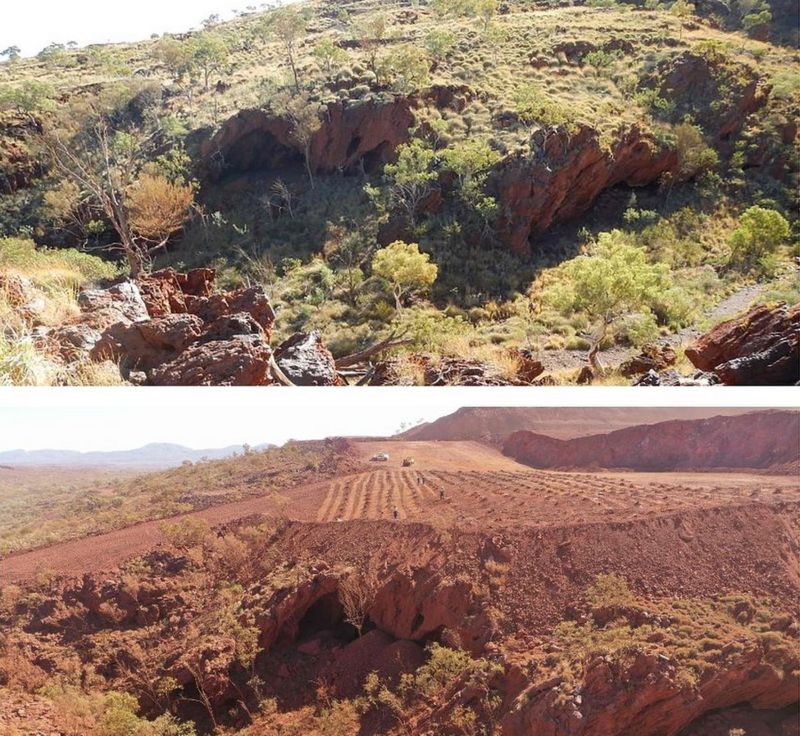
When Rio Tinto completely destroyed a forty-thousand year old Aborigene site I bet they were thrilled with all that money they got…
Now, if you notice the before picture, it has plants and the soil is covered and more resistant to erosion and being able to hold moisture better.
The after picture shows a completely destroyed/leveled land without any protection from the elements. It clearly holds more heat than before and the wind and rain will further destroy what is left of Mankind’s 40k year history. So we are all impoverished with such stupid actions.
Who would do such a thing to the caves of Lascaux, and why do you think it’s ok in Australia?
I’m not a believer in climate change as a cause but I believe actions have consequences and unsustainable practices must be reigned in.
I understand oil and ores have to be mined, but I also believe if there are no controls, that we will continue to make large areas of land unusable for generations to come.
 , but it’s the politicians who approve budgets and large scale projects. If the politicians believe so strongly about climate change and are more than willing to create a carbon tax and sign international treaties in Paris’ more glamorous locations, why are they allowing such enormous carbon-intensive projects for their nations?