You said:
There were building codes over 100 years ago. The first building codes in the US came about in 1788.
It seems like, Tugboy, you have a memory or an arithmetic problem, not me.
You said:
There were building codes over 100 years ago. The first building codes in the US came about in 1788.
It seems like, Tugboy, you have a memory or an arithmetic problem, not me.
By Glenn Mathewson Issue 317 - Aug/Sept 2023
Synopsis: Code expert Glenn Mathewson overviews the evolution of building codes in the U.S., detailing how various official organizations were formed to publish the first building standards and how this evolved into the International Code Council and the I-Codes we are familiar with today.
“Building codes are written in blood.” If you haven’t heard this before, it’s a reference to the main motivation that has generated the development of new building codes for centuries. While there are many motivations for the revision, creation, and maintenance of building codes, codes are mostly reactive in nature. Be it structural collapse, fire, or disease caused by water contamination or unsanitary waste disposal, the origin of building and health codes often can be traced to human tragedy.
At least as early as the 1600s, colonial cities such as Boston had codes called “building acts.” As you might expect, the primary purpose of these acts was to prevent the cities and towns from burning to the ground. The default regulation was to prohibit homes from being built and roofed with wood or other combustible materials. Clearly this was a top-down solution, as building human shelter from noncombustible materials such as brick, stone, and tile was not affordable for the large majority of the population, and it still isn’t today. Housing for the working class was a controversial topic in the United States even before the United States existed. But a building act is only as good as a government’s efforts to enforce it, and many of the jurisdictions at that time didn’t have a specific department or inspectors to do so. The insistence of governments to ban or limit wood carried on for centuries, as did the defiance of the people building homes and the fires that destroyed them.
Great moments in the evolution of building codes
1600s – Cities such as Boston create building acts to prevent catastrophic fires
1850s – New York introduces plumbing design and plan review requirements
1866 – National Board of Fire Underwriters (NBFU) is created
1897 – NBFU publishes the NBFU No. 70, the first National Electrical Code (NEC)
1905 – NBFU publishes the Building Code Recommended by the National Board of Fire Underwriters
In 1866, a group of insurance underwriters (the folks footing the bill to rebuild cities) formed the National Board of Fire Underwriters (NBFU). In the late 1800s the NBFU began investing heavily in reducing life- and property-threatening fires and their financial impact on the underwriters. They introduced the Building Code Recommended by the National Board of Fire Underwriters, the first “model” (suggested) code written to be a set of recommendations to governments. Free copies of this code and training support were provided to any jurisdictions that wanted to adopt it, an early example of an effective public-private benefit. Some cities continued to use their own unique building codes, but many jurisdictions eventually did adopt the NBFU’s Building Code or used an altered version of it.
Around this same time, health and sanitary codes were also becoming more common. While this doesn’t immediately sound related to construction, it very much is. What we would call plumbing codes today were provisions included in the early health codes. Water closets, privies, and cesspools were the topics of discussion. By the 1850s major cities such as New York had introduced significant plumbing requirements, including licensing and plan submission, all regulated by health code provisions.
While plumbing codes and building codes did improve public safety and health, they varied greatly across U.S. cities by the 1920s, and “specification codes” had become common. Instead of offering construction methods and building material options, specification codes specified exactly what to do. The federal government was receiving a lot of complaints about the increased cost of construction that resulted. In response, the Department of Commerce created the Building Code Committee to research prevailing U.S. codes and draft code recommendations for state and city governments. Over the next several decades, with the goals of reducing construction costs and increasing output, the federal government funded research subjects such as fire-reduction strategies, reliable plumbing standards, lumberload properties, and framing best practices. These reports became a resource for code development across the nation.
1921 – U.S. Department of Commerce creates the Building Code Committee
1927 – ICBO creates the first “model” building code published by a code-official organization
1930s – Building codes become less specific and more performance based
1940s – Lumber span tables, nailing schedules, and new prescriptive design codes are introduced
1942 – National Association of Home Builders (NAHB) is founded
By 1940 three organizations of building officials had formed: the International Conference of Building Officials (ICBO) in the western part of the United States, the Southern Building Code Congress International (SBCCI), and Building Officials and Code Administrators International (BOCA) in the Northeast. By the 1950s all three organizations had developed their own model building codes to recommend to state and local governments. Building officials wanted code provisions that addressed more than just fire safety, the primary subject of the NBFU code. Structural provisions were included that would help guide designers toward building better structures and away from unnecessary overbuilding, but each region had unique concerns and experiences.
In the decades that followed, the building industry strove to unify codes and increase flexibility and options. “Performance codes” became more prevalent as a result. Performance codes describe the end results the codes seek rather than specifying exactly what construction methods to employ and which building materials to use. One example of this design flexibility is the requirement for a “fire-rated wall” that would resist fire for a period of time instead of prescribing a specific material or wall assembly to achieve that goal. Design professionals and engineers were given much more influence in deciding how homes would be built to meet the performance objectives required by the code.
After World War II and the housing boom that followed, the ICBO (the western group) began developing and publishing dwelling house pamphlets. These pamphlets were created alongside new editions of the ICBO’s Uniform Building Code (UBC) and provided “prescriptive design codes” in the form of span tables, nailing schedules, and other “recipes” for construction derived from the engineering and performance standards in the complete building code. The goal was to simplify house construction and reduce design costs. In later decades, the SBCCI (the southern group) would also produce a dwelling house pamphlet.
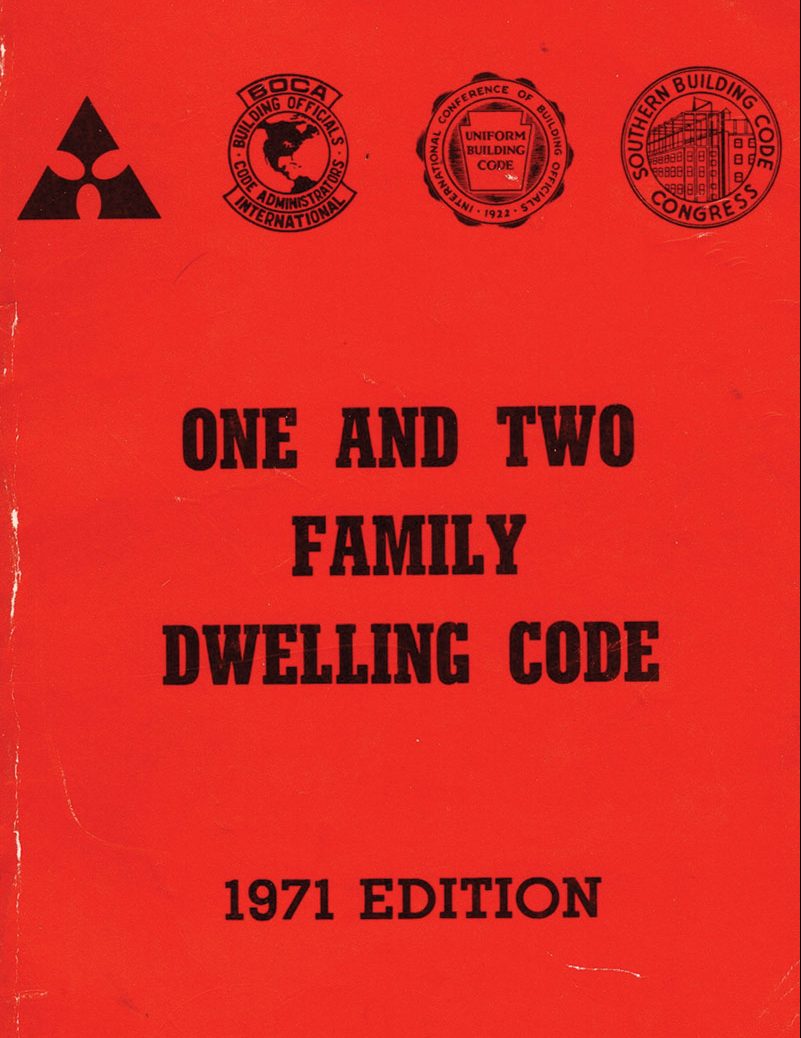
By the 1960s home building had become a national business, and architects, designers, and builders who worked on projects nationwide didn’t appreciate the confusion and inefficiency of having four different model codes across the country, three from building officials and one from insurance underwriters. Voicing their dissatisfaction resulted in the four separate organizations getting together to publish the 1971 One- and Two-Family Dwelling Code. This code also included building, plumbing, and mechanical provisions. And in 1972 the three noninsurance organizations combined to form the Council of American Building Officials (CABO). However, even after the formation of CABO, both the 1971 and the 1975 editions of the One- and Two-Family Dwelling Code were credited to all four individual organizations. By the 1979 edition, the National Board of Fire Underwriters, which by then had become the American Insurance Association (AIA), stepped out of the code publishing business completely, and CABO became the publisher.
1945 – Beginning of post–World War II housing boom drives demand for simplified “dwelling house” code pamphlets
1971 – ICBO, SBCCI, BOCA, and American Insurance Association (AIA) collaborate to create the One- and Two- Family Dwelling Code
1972 – ICBO, SBCCI, and BOCA form the Council of American Building Officials (CABO)
1973 – U.S. energy crisis begins as oil production declines
1975 – Second edition of Oneand Two-Family Dwelling Code is published by ICBO, SBCCI, BOCA, and AIA
The formation of CABO was perfect timing for the federal government to again play a major role in influencing how homes would be constructed in the United States. With the energy crisis underway, the 1975 Energy Policy and Conservation Act enabled the Department of Energy to provide the necessary funding for CABO to develop a model energy code. By 1977 the Model Code for Energy Conservation was published. While some jurisdictions across the country did adopt it, this early energy code was not widely accepted. Energy provisions were not included in the CABO dwelling code directly, so a local government would have had to actively adopt the model energy code individually. CABO continued to publish its One- and Two-Family Dwelling Code every three years, and in the 1995 edition an agreement was made to include the electrical provisions from the National Fire Protection Association’s 1993 National Electrical Code (NEC).
1977 – The Model Energy Code is published by CABO with funding from the federal government
1979 – Third edition of One- and Two-Family Dwelling Code is published by CABO. AIA steps away from code publishing.
1994 – International Code Council (ICC) is formed
1995 – NEC provisions are added to CABO’s One- and Two- Family Dwelling Code
1995 – ICC publishes first “I-Code,” the International Plumbing Code (IPC)
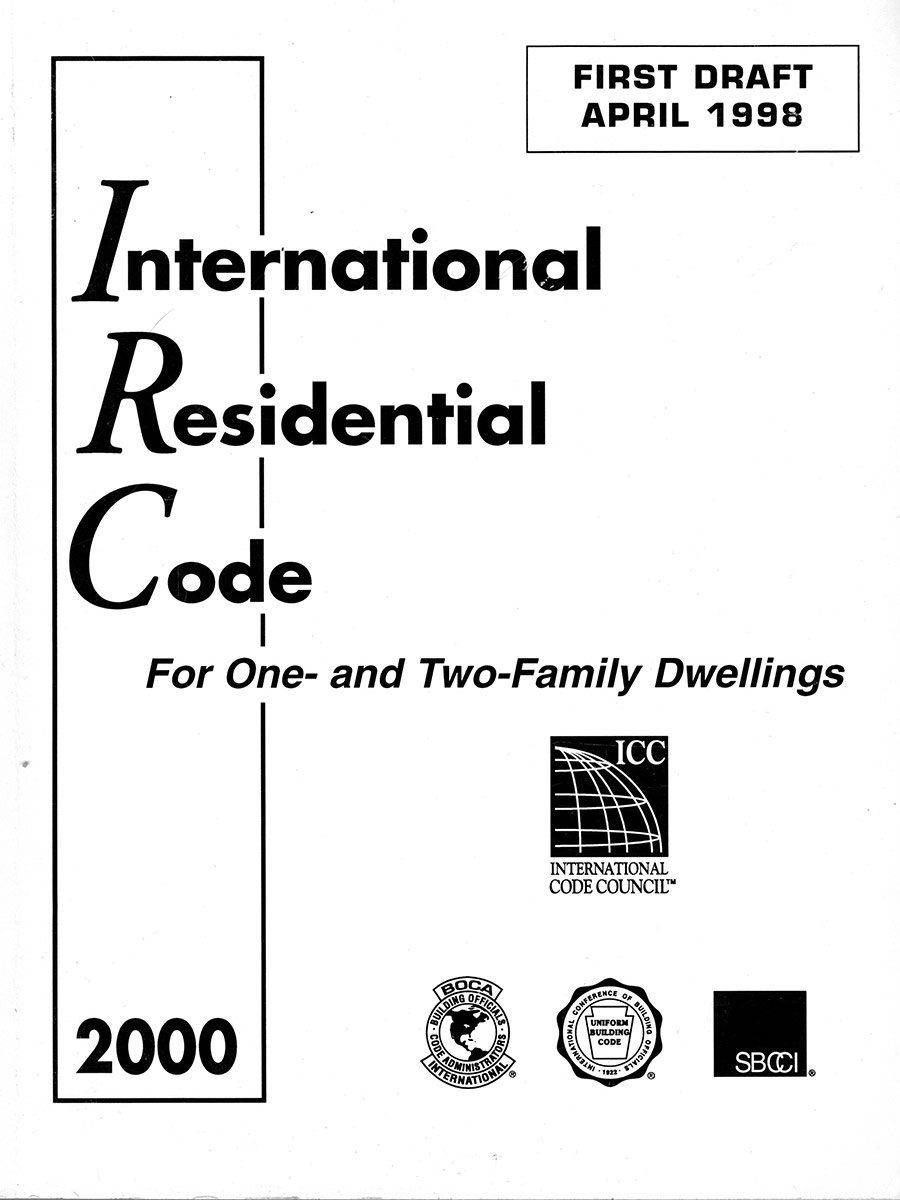
Even with the ongoing effort to unify building standards, CABO’s dwelling and energy codes were not universally adopted, so in 1994 the International Code Council (ICC) was formed, publishing its first codes in 1995. In 2000, the first International Residential Code (IRC) was published and began to be adopted across the nation. From 1971 to 1998, individual jurisdictions could still choose between codes published by ICBO, SBCCI, and BOCA, or they could adopt CABO’s One- and Two-Family Dwelling Code. But by 2000 the IRC was for all intents and purposes the only code publication to choose from, and widespread adoption followed. In 2002, the three legacy organizations officially dissolved.
The federal government still does not have direct authority over building codes, but it does have influence in the form of providing or withholding federal grants to states that reach or fail to reach certain thresholds of energy code adoption. After the creation of the ICC and the publishing of the 2000 IRC, energy codes began to gain popularity, mostly due to changes in society and continued federal funding, but partly due to residential energy provisions being included directly in chapter 11 of the IRC. This made it easier and more practical for a government to adopt and enact energy conservation provisions, as otherwise it would have to intentionally remove them via amendment.
The completed versions of the I-Codes are documents essentially lobbied to state and local governments for adoption as law. Local jurisdictions have the authority to adopt the codes, reject specific provisions, or introduce more stringent versions of their own, depending on the authority granted by the state government above them.
Shortly after the publication of the first IRC, many began to believe that special interest groups were dominating the direction the code was taking. For example, the 2009 IRC included a controversial mandate for all new homes to include fire sprinkler systems. Many in the industry saw this as an expensive regulation not based on society’s concerns or needs but on the desires of specific interested parties in the industry. Over a decade later, most governments still reject this recommended mandate.
2000 – ICC publishes first International Residential Code (IRC), and adoption/amendment begins across the nation
2002 – ICBO, SBCCI, and BOCA officially dissolve
2009 – Controversial single-family home fire-sprinkler mandate appears in the IRC
2015 – More accessible, online code-development process is implemented to simplify proposal submission and collaboration and increase government member participation
2024 – Controversial change in International Energy Conservation Code (IECC) development approval process, from general voting procedure to committee acceptance
In 2015, the ICC implemented an online process for code development and voting. This was to ensure that a broader voice of building and fire professionals could be heard and a more balanced final outcome would result. The ICC process for developing the next edition of its codes is open to everyone and is completely transparent. Nothing is sacred, in that anyone can suggest a new provision or ask for a change to an existing code. And all proposals can be modified by others before being voted on. The final vote is made by ICC government members (the jurisdiction as a whole), which includes state and city government employees working in public health, safety, and general welfare.
A more recent change in the code development process is meant, in part, to address another controversy. Each ICC government member is allotted a certain number of voting members (4 to 12) based on the population of the jurisdiction, but not every jurisdiction fills those positions or maximizes its number of final, online votes. During the development of the 2021 International Energy Conservation Code (IECC), some proposals requested an increase in minimum R-value requirements but were rejected throughout the entire in-person process, including two hearings. However, an organization primarily interested in building energy efficiency made a concerted effort to assist like-minded jurisdictions in filling all their available voting seats, and in a surprise to many, the proposals were approved in the final online vote. These changes went beyond what many felt were reasonable and were presumably a result of the efforts to maximize affirmative votes. Likely related, the ICC moved the development of the 2024 IECC to a completely different process, using ANSI-standards development protocols that rely on committees to make the final approval. Additional changes were recently made to the process of developing all the 2027 I-Codes, starting in 2024. Like fire sprinklers, many jurisdictions are rejecting the new energy code and adopting the 2018 code instead. Unlike with sprinklers, however, the federal government is promoting and funding energy code updates in states, so many others are moving to the more robust edition.
The history and major milestones of the U.S. building code system are complex and profound, and this is just an overview of the entire story. The construction industry is also complex and is constantly changing with new materials, economics, societal expectations, and human creativity. Building codes are intended to change alongside these variables. However, as stated in the preface of the original 1927 Uniform Building Code, “The code is not, and never will be, perfect.”
Glenn Mathewson is a consultant and educator with BuildingCodeCollege.com.
From Fine Homebuilding #317
RELATED STORIES
Well, this thread has detoured magnificently.
Goodnight, all.
A deal maybe? Declare your state exempt from rules as long as it becomes illegal to send any aid to that state. Whole place burns up, sinks, floods, falls in a sinkhole, falls over, whatever, you are on your own.
This would be the land equivalent of the worst FOC state that never inspects or enforces any rules at all.
We have that too, building codes are on the state and county level. Nome Alaska deals with cold, Florida deals with hurricanes, etc.
People looking at buildings from the 1600s and 1700s here and saying “Look, no rules, they lasted just fine anyway” are suffering from survivor bias. The crap buildings are long gone, the best ones survived.
Regardless what OCS stands for, not sure why I have Ocean Chart Service stuck in my head, when someone asks where the useless administrators in NOAA are, that’s my answer.
I’m not asking for paper charts back, I’m pointing out the transition has been terribly handled. I’m very much in favor of ENCs, but ripping up paper charts with no thought as to what users actually need paper charts - mostly in form of testing and various small vessel operations- it’s been brutal. Drawing NCCs for pilotage sucks, they are generally inaccurate and do not have the information you need to safely navigate, and are questionably accurate.
The Coast Pilot would be a lot more useful if the local knowledge parts were updates some time since the days of Thomas Jefferson. As I said to AKBJR, most of the local knowledge portions of the coast pilot are circa 1995, and generally inaccurate. But other organizations still test based on this information, which is really just a waste of everyone’s time. Sure, you can ask me about a prominent building showing time and temperature, visible 16 miles off shore, but that doesn’t actually help anyone when the time and temperature hasn’t worked in 5 years, and taller building have been built all around the building in question. The coast pilot is absolutely useless, and should be replaced by a website.
Every piece of paper put out by OCS is questionably useful, and more likely a waste of money.
I get where you’re coming from. Vermont outside of Burlington runs on the same principal, and all of that works well…until it doesn’t. Like the user noted about chucking 18 crew off a vessel needing 20. One obvious potential problem in your housing analogy is when a plurality, not even majority, of people who have homes that are good enough have an issue with that house which ends up injuring them or damaging property for which they want to have an insurance claim, if they have insurance. Then you’re looking at costs that are transferred onto the rest of us. And the whole milling your own lumber. Sure. Sounds great. How many of those users are kiln drying that lumber in order to have it stable so it doesn’t move over time and cause structural issues? Are there some homesteaders who can pull that off safely to avoid the potential easy to see potential risks above? Absolutely. Is that the majority of homesteaders? Hell no. See Dunning-Kruger. Does that mean government, to protect idiots, creates these regulations? Yup. Do many people have a philosophical problem with that approach? Of course. Is burning the government down the way to remedy everything? It is ONE way to do it, but I don’t want to live through the obvious and not so obvious chaos.
So are there more reasonable ways to fix the mess? I sure hope so.
But that is the MAGA baseline.
Who are the folks “that least need them”? Serious and sincere question.
Simple. Folks who earn a lot of money. A lot of money seems to be roughly $400,000 and above, yearly. I’d opine such earners to be free of significant worry, other than medical disasters.
True. But those people are also the ones paying the largest percentage of taxes. The “wealthiest one percent” theory has gone on far too long. From “USAFacts.org” Most of the government’s federal income tax revenue comes from the nation’s top income earners. In 2021, the top 5% of earners — people with incomes $252,840 and above — collectively paid over $1.4 trillion in income taxes, or about 66% of the national total. If you include the top 10% — everyone who made at least $169,800 — that figure rises to $1.7 trillion, or 76% of the total.
The top 50% of earners contributed 97.7% of federal income tax revenue. CBS News posted "But it’s the top 50% of earners who contribute almost all of the nation’s federal taxes — nearly 98%. The bottom 50%, who individually make below $46,637 annually, account for about 2.3% of the country’s tax receipts.
I consider that to be fair. To paraphrase an old saying, “Grumble you may, but pay you must.”
Surely, as a supposed chaplain, you’re familiar with Luke 12:48, which states, “From everyone who has been given much, much will be demanded; and from the one who has been entrusted with much, much more will be asked.”
I continue to pay more than 20% in taxes in retirement. I live in what is still a great country. That’s not even mentioning the thousands I pay in property and sales taxes.
This why the personal exemption should be raised to $100,000 a year, and people making less than $100,000 should not be wasting time and money filing tax returns. That would also require a lot less employees at the IRS.
When Willy Sutton (a famous bank robber ) was captured the press asked: “Why do you rob banks.” He responded: “because that’s where the money is.”
The IRS follows the same theory. They go after people making over $200,000 because that’s where the money is.
The IRS avoids people making $$$ tens of millions because it consumes too many resources to litigate with them.
If memory serves, wood and clay chimneys were outlawed in many places when the USA was still the 13 colonies. Chimney fires got annoying.
For me the verse that rings true in relation to the wealthy paying a higher percentage of taxes is Mark 12:41-44:
Jesus sat down opposite the place where the offerings were put and watched the crowd putting their money into the temple treasury. Many rich people threw in large amounts. But a poor widow came and put in two very small copper coins, worth only a few cents.
Calling his disciples to him, Jesus said, “Truly I tell you, this poor widow has put more into the treasury than all the others. They all gave out of their wealth; but she, out of her poverty, put in everything—all she had to live on.”
These are literally Jesus’s words in relation to wealth and the fact that rich people giving a lot means less than poor people giving less in value but more in relation to their relative wealth, or lack there of. I can’t help but feel that giving to God or giving to your country is similar in this sense, and when in doubt I side with Jesus. If poor people give anything, which they absolutely do in the form of sales tax, property tax, gas tax, just to name a few, it means more than rich people giving a greater amount.
From my observation the US has more Pharisees claiming Christianity than actual Christians by a large margin.
I must confess that I follow no religion, but I hold my greatest admiration for folks who know right from wrong, and live it.
Like everyone else Christians are imperfect, and I try my best to resist the very human urge to judge others, whether they claim to be Christian or otherwise. I do however begin to question people’s motives when they treat wealth as somehow virtuous or admirable, while at the same time claiming to aspire to live their life like a man who had zero worldly possessions, encouraged others to give all theirs away, and whose only single act of violence ever was casting money changers from the Temple.
It is sad that government employees are being let go, BUT it was equally sad when the financial crisis of '08 sent a good portion of the US Lake fleet to the wall in October. When oil went down in (insert any of the bust cycle dates here) it was sad when the white vans rolled up in Morgan City/Fourchon/Venice/Cameron, etc. no one really makes this big of a fuss when mariners go home unwillingly or a steel plant shutters yet it seems government layoffs are a pearl-clutching moment.
Is the cutting deep an painful? Yup, but the bandage needs to be ripped off, I suppose. One of the people I know who is screaming the loudest about NOAA is also someone who does NOT use any of the NOAA forecast products but swears by the Windy app as he claims “NOAA forecast are junk” (of course he also rapidly anti-Trump, so anything that occurs is the rise of Lucifer).
Remember the moratorium? Libs were rejoicing Americans were being sent home & some of the last of small businesses in the GoM were finally being shuddered. It’s not that people are upset the government rolls are shrinking, its whose idea it was & who’s orchestrating it. To getting the ball rolling on new ships for maritime academies to the tax cut for every working American in 2017, they just complain about everything all the time. Venting is healthy, good for mental health & they need all the help they can get.