
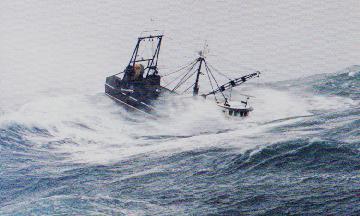
For small ships following seas can be dangerous. With insufficient bow buoyancy, a large wave approaching from behind can tend to lift the stern and drive the bow into the water. This can result in a sudden broach and even capsize, also a pitchpole is possible.
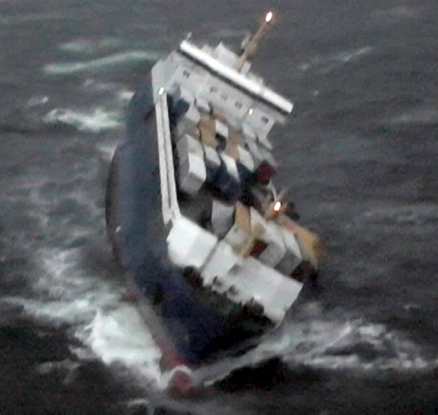
For large ships the biggest danger of a broach is when the ship is riding on top of a wave crest especially if the wave length equals the length of the ship. The stability at that instant is reduced dramatically, the ship can start yawing which cannot be corrected by the rudder and if the speed is not taken back, if there is time for that, immediately a broach can follow.
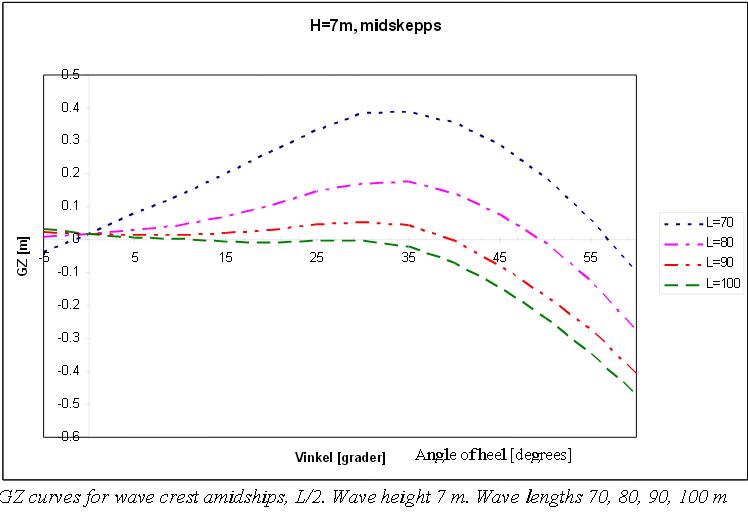
The influence of the wave length on the GZ curve of the Swedish Ro-Ro vessel Finnbirch, which broached in November 2006 in the Baltic Sea, is clearly shown in the picture. The stability of the ship was found to be ‘sensitive’ which aided to the broach.
The second officer of the Dutch ship Mauritsgracht, who was on an opposite course, saw it happen before his eyes. On the radar he could see that the ship’s speed was abnormally high, over 19 knots while the maximum hull speed for a ship of 156 m is 16.7 knots. He noticed that the ship was yawing heavily from left to right after which it suddenly broached.
As a result of the sudden and violent broach major acceleration forces developed which broke many of the lashings causing the cargo to shift. Later on it was found that the lashings were below standard. The inspecting authorities were aware of this but took no action…
Stunning was that it became evident during the interviews that the ship’s captain was not aware of the ship’s rather special stability characteristics with larger heeling angles under certain cargo conditions nor how the stability curve of the ship should be interpreted. He was not alone among the masters of the shipping company in this respect.
The master of Finnbirch could not remember that the phenomena which can develop with following seas had been presented during his training at the ship officer’s school. According to the minutes of the maritime inquiry following the sinking, he was of the opinion that it was advantageous to proceed at full speed in a following sea and thereby pass the waves and reach a condition which corresponded with meeting a head sea. I rest my case…The report on the accident can be found here.
The master as well as the other masters of the company and the company itself had never heard of the IMO circulaire 1228 named ‘REVISED GUIDANCE TO THE MASTER FOR AVOIDING DANGEROUS SITUATIONS IN ADVERSE WEATHER AND SEA CONDITIONS’ in which also the dangers of followings seas are outlined.
The technical university of Hamburg researched 12 similar incidents, including that of the Finnbirch and published the report.
[video]https://youtu.be/Vx9FmEq5D6A[/video]
The ship in this video is rolling heavily, up to 40°. It sails in following seas at about the same speed as that of the waves, no wonder…